Bai Dinh Pagoda: Ninh Binh’s Record-Breaking Marvel
Want to find out more about the wonders of Asian architecture? Here is an opportunity to visit Bai Dinh Pagoda, the most dramatic Buddhist shrine in Vietnam and Southeast Asia; known not only for its grand and amazing architecture but also for the wonderful serenity of the place. It is in northern Vietnam, more specifically, in the terrestrial Halong Bay of Ninh Binh. Come and retrace the footsteps of ancient Vietnamese kings and let the beauty and tranquility of the place overwhelm you... Follow the guide!
Written by Oliver PHUNG (Tour Guide)
Updated on Aug 20, 2026
0 comment
Oliver Phung is a Northern Vietnam-based tour guide and blogger. His favorite topics to write about include cuisine, culture, travel, and under-the-radar experiences. Oliver possesses a deep, detailed understanding of the region, from the indigenous culture of the Hmong in the Northwest to the highland lifestyle of the Tay in the Northeast. Whether he is exploring ancient architecture or geological landscapes, he is always eager to share his insights with his readers.
Beyond his work at Kampá Tour, he produces specialized travel content on platforms such as Reddit, Instagram, LinkedIn, and various other publications.
Entry: free. The electric cart, the stupa and the guide are the paid extras.
Electric cart: 150,000 VND per adult round trip, raised from 60,000 VND in February 2026.
Opening hours: 6:00 AM to 9:00 PM daily.
Time needed: 2 to 3 hours with the cart, 4 hours or more on foot.
Don't skip: the ancient pagoda in the caves up the mountain. It is the oldest part and the part most day tours leave out.
Best for: travelers interested in Buddhist architecture and scale. Less so if you came to Ninh Binh for landscape.
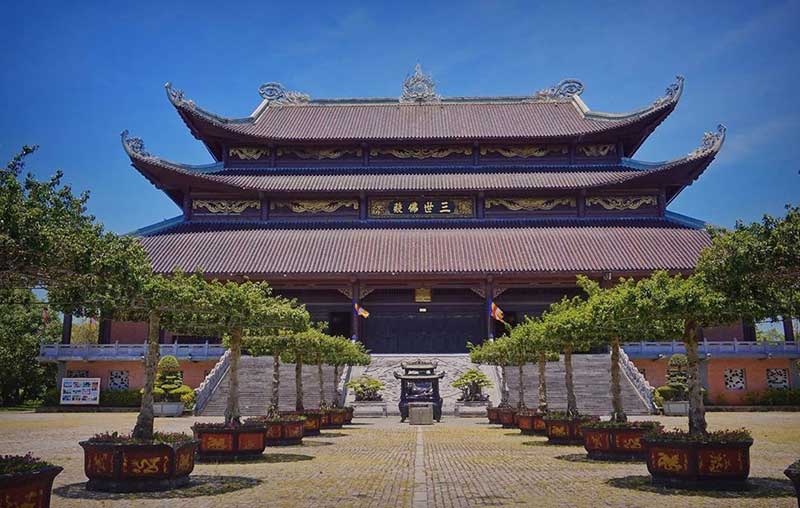
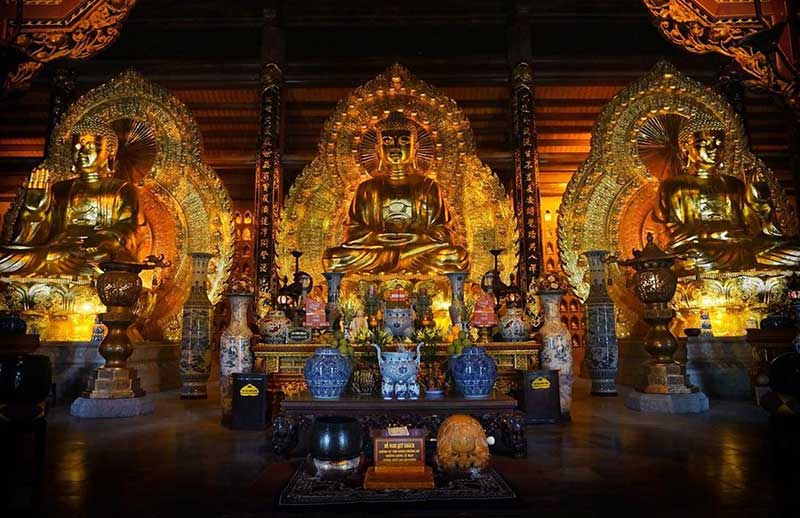
Phap Chu Palace in Bai Dinh Complex
Two pagodas, one name: Ancient Bai Dinh and New Bai Dinh
Getting this straight before you arrive saves a lot of confusion at the gate, because the two sites feel nothing alike.
The ancient pagoda sits on Mount Dinh, roughly 187 metres up, reached by around 300 stone steps. It was founded in 1136 under the Ly dynasty by the Zen master Nguyen Minh Khong, who came to this mountain searching for medicinal plants to treat the king and stayed to build a temple in the caves. The shrines are inside the rock: small, cool, dim, and about nine centuries old. In 1997, before the new complex existed, Bai Dinh was recognised as a national historical and cultural relic site.
The new pagoda lies about 800 metres below, built in phases between 2003 and 2010 by craftsmen brought in from traditional villages across Vietnam. Everything people photograph is here: the arhat corridors, the giant bronze Buddhas, the bell tower, the stupa. It is enormous, it is modern, and it was designed to be a major Buddhist centre for Southeast Asia rather than a village temple.
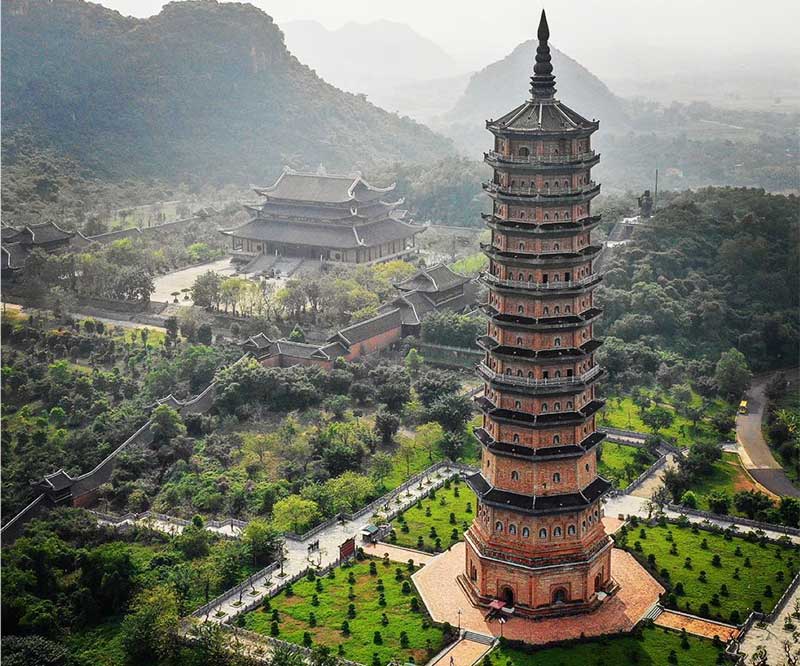
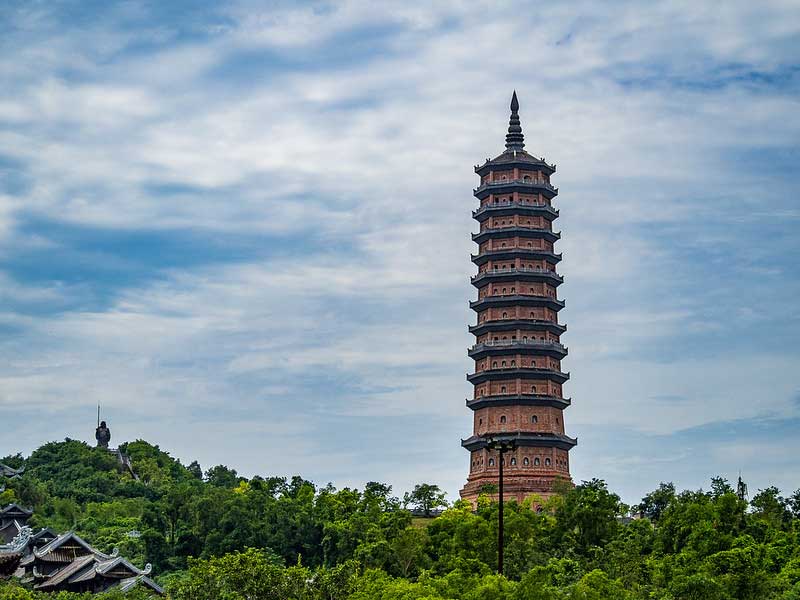
Bai Dinh Pagoda and Xa Loi Tower from above
Most day tours cover the new complex and skip the climb. That is the single biggest thing to know: if you want the part that is genuinely old, you have to ask for it and leave time for the steps.
Is Bai Dinh Pagoda worth visiting?
Yes, if Buddhist architecture, craftsmanship and sheer scale interest you. The bronze work is real, the stone carving was done by hand, and standing at the foot of a 100-tonne Buddha is not something the photographs prepare you for.
Be clear about what it is, though. Most of what you will walk through was completed in 2010, not in the 12th century, and the site is run as a large managed attraction with ticketed shuttles, souvenir stops and a foot-bath service. Visitors regularly describe the new complex as feeling closer to a religious park than a quiet temple, and that reaction is fair rather than unkind. It was built at that scale on purpose.
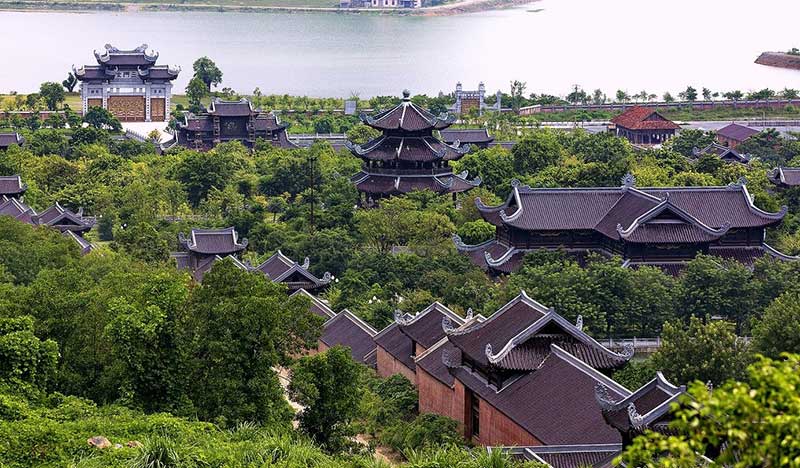
The complex is located on Mount Dinh, a limestone mountain covered in lush vegetation
Two practical things decide whether people enjoy it. The first is heat: there is a lot of walking, much of it in the open, and a midday visit in summer is genuinely hard work. The second is expectations about time. Bai Dinh does not slot in between a boat tour and lunch. Give it half a day or leave it out.
Who should skip it: travelers with two days in Ninh Binh who came for the rivers and the rice fields. Who should not: anyone interested in how a country builds a religious monument in the 21st century, and anyone who wants to see the mountain caves.
Tickets, opening hours and how long you need
Entry to Bai Dinh is free. What you pay for is transport across the site, the stupa and, if you want one, a guide.
Ticket prices
Entrance to Bai Dinh Pagoda: Free.
Round-trip electric cart: 150,000 VND/adult; 100,000 VND/children from 1 m to 1.3 m tall.
Full shuttle service: 300,000 VND/adult; 210,000 VND/children from 1 m to 1.3 m tall. Includes cart transfers between the main stops, admission to the stupa and a foot-bath experience.
VIP electric cart: 4,000,000 VND.
Tour guide: 500,000 VND per tour.
Based on the 2026 Ninh Binh tourism tariff, with the revised electric-cart fares effective from 15 February 2026.
Opening hours
Daily: 6:00 AM to 9:00 PM.
During the day: you are free to walk the grounds, visit the halls and climb the stupa.
After dark: the grounds stay open for walking, but shuttle services stop and some indoor areas close earlier.
Do you have to take the electric cart?
No, and this is worth understanding because the answer changed recently. The cart fare went from 60,000 VND to 150,000 VND per adult in February 2026, which is why you will find travel articles and reviews quoting wildly different numbers, and why some 2026 visitors felt pushed into paying.
You can walk. The catch is distance: it is roughly three to four kilometres from the car park to the main halls, uphill in places, with very little shade. Walking is a reasonable choice on a cool morning and a poor one in July.
How long to allow: two to three hours with the cart covering the new complex, four hours or more if you walk it, and add another hour if you are climbing to the ancient pagoda. Travelers who try to do Bai Dinh in ninety minutes end up seeing the entrance and the first hall.
What to see at Bai Dinh
The new complex is laid out as a climb: you move up through halls dedicated to the Buddha of the past, the present and the future, with the stupa and the mountain above. Below are the stops worth slowing down for.
The Arhat corridors
Two covered walkways running roughly three kilometres in total, lined with 500 arhat statues carved from Ninh Binh bluestone, each between two and two and a half metres tall. No two faces are the same: the carvers gave each one a distinct expression, running through joy, anger, boredom, doubt. Walking the corridor slowly is the best twenty minutes on the site, and most groups hurry it.
Phap Chu Hall
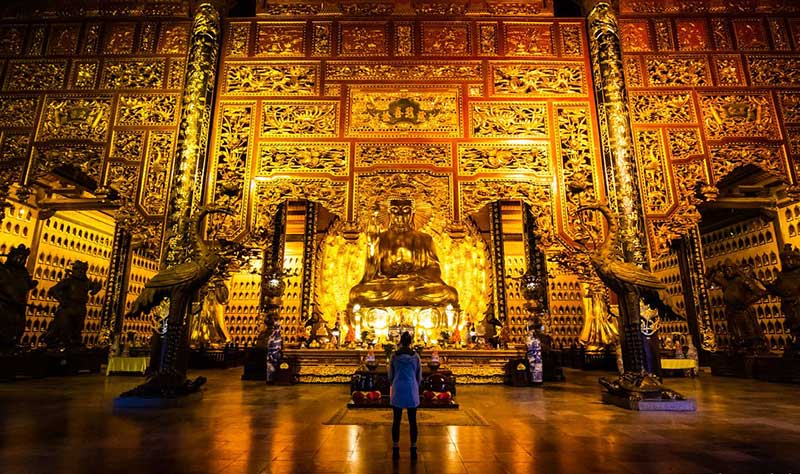
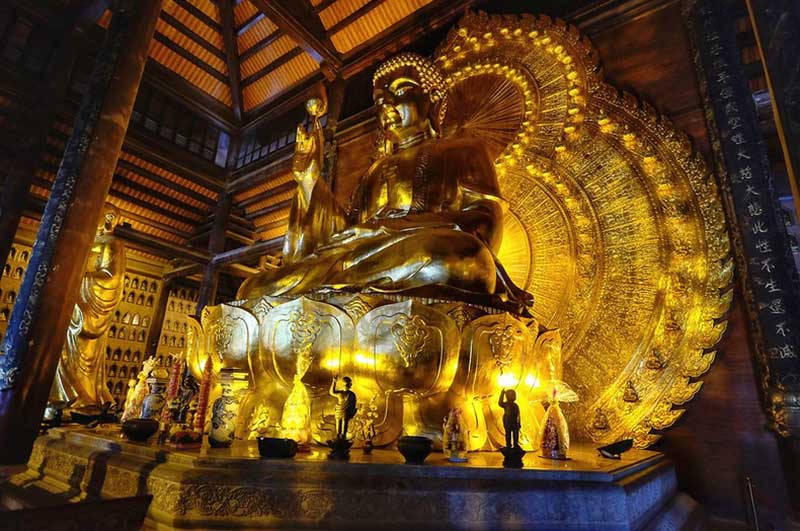
Twenty-two metres high, and home to a 10-metre bronze Sakyamuni Buddha weighing 100 tonnes, the largest gilded bronze Buddha statue in Asia. The hall is also where you will see the most active worship, especially in the mornings.
People worship in the Phap Chu Palace of the Bai Dinh complex
Tam The Hall
The largest structure on the site, holding three bronze Buddhas of 50 tonnes each representing past, present and future. Together with Phap Chu it accounts for around 1,000 square metres of hall space.
Tam The Palace
Closer to the statue of Buddha Sykamuni in the palace of Phap Chu
The Bao Thap stupa
Thirteen storeys and 100 metres tall, west of Tam The Hall, holding Buddha relics gifted by India and Myanmar. There is a lift as well as stairs, and the view from the top is the reason to go up: the whole complex laid out below, with the limestone hills behind it.
The base is hexagonal, built from Bat Trang fired brick in a Ly dynasty decorative style, with small stone Buddhas arranged up the six edges. Admission to the stupa is included in the full shuttle package.
The Xa Loi stupa, the tallest stupa in Asia
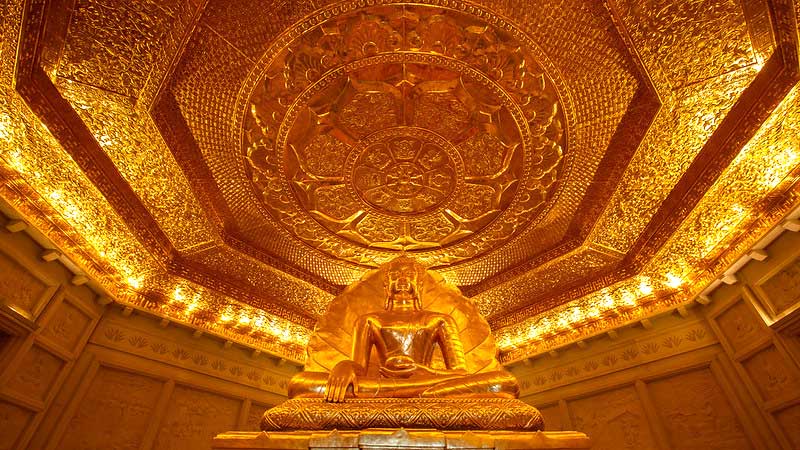
The Buddha statue in the center of the first floor of the stupa
The bell tower
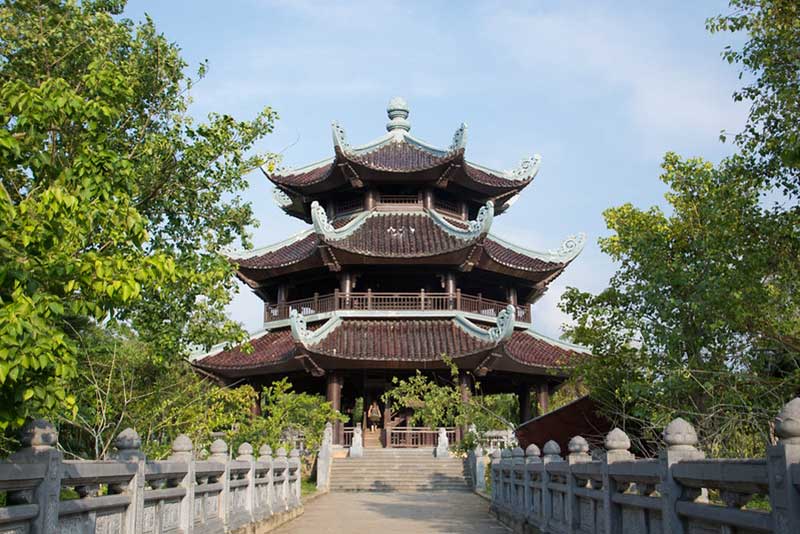
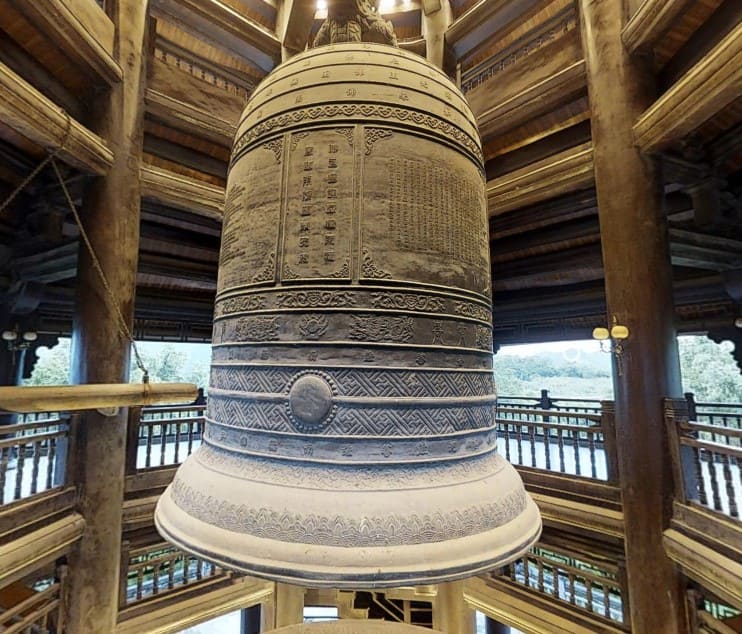
An eight-sided, three-tiered tower east of the main halls, built to house a 36-tonne bronze bell, the largest in Vietnam. Beneath it sits a bronze drum of around 70 tonnes. Local belief holds that anyone who hears the bell receives the Buddha's blessing, which is a good reason to be nearby when it is struck.
The bell tower in the Bai Dinh complex
Dai Hong Chung, the 36-tonne bronze bell at Bai Dinh
The ancient pagoda and its caves
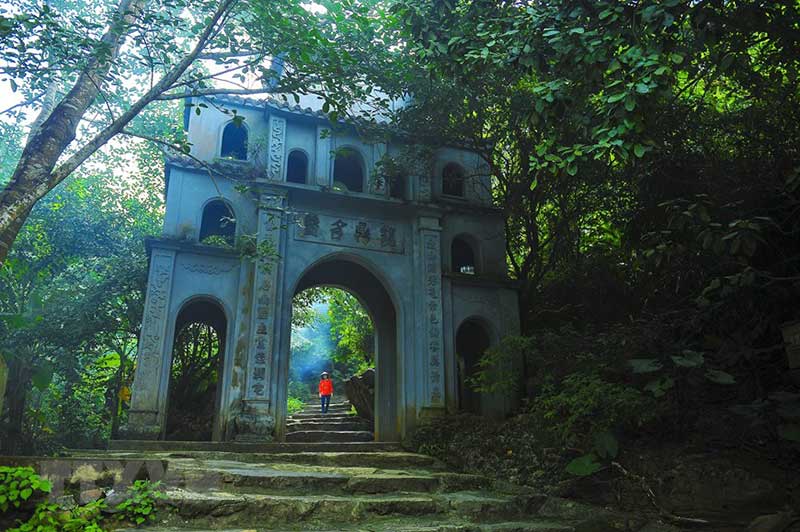
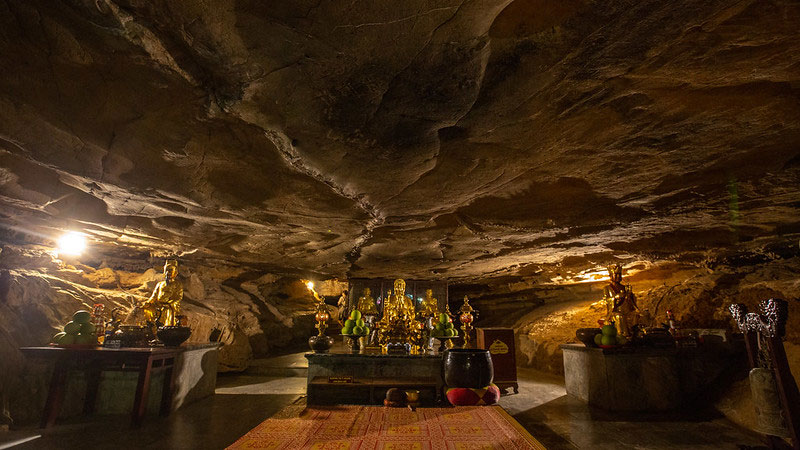
Around 300 steps up the mountain is the part of Bai Dinh that predates everything else by nearly nine centuries. The temple is built into two caves. Sang Cave, the Bright Cave, is on the right and houses the Buddhist sanctuary dedicated to Sakyamuni. Toi Cave, the Dark Cave, is on the left, about 25 metres deep and 15 metres wide, and is associated with the Mother Goddess tradition. The caves are cool and dim, with stalactites, dragon-shaped stone steps and natural skylights that send shafts of light towards the altars.
You have to climb 300 steps to reach the ancient Bai Dinh Pagoda
In Sang Cave, four large characters — Minh Dinh Danh Lam — carved under King Le Thanh Tong praise the beauty of the site. Traditional altar figures represent the Buddhas of the past, present and future, alongside Sakyamuni and Avalokitesvara. Come out through the lower exit for a view over the green valley.
Inside the Dark Cave
If your legs or the clock will only allow one of the two Bai Dinhs, and you have already seen large temples elsewhere in Asia, this is the one to choose.
Ngoc Well
At the foot of the ancient pagoda, Ngoc Well is about 1,000 years old, nearly 30 metres across and around 6 metres deep. Ninh Binh Tourism lists it as the largest well in Vietnam. According to local tradition, Zen master Nguyen Minh Khong drew water here to prepare medicine; the clear, jade-green water is still used for Buddhist offerings and is said never to run dry. It is worth a short stop because it belongs to Bai Dinh's older sacred landscape rather than the monumental architecture of the new complex.
The records, and what they actually mean
Bai Dinh is often introduced through its record list, which is accurate but not very useful on its own. Here is the list, with the part that matters: almost every record is about bronze casting and stone carving done by Vietnamese craftsmen within the last twenty years. The records are a statement about contemporary Vietnamese craft, not about antiquity.
Largest gilded bronze Buddha statue in Asia: the 100-tonne Sakyamuni in Phap Chu Hall.
Largest bronze Maitreya Buddha statue in Southeast Asia: 100 tonnes, in the open air.
Largest bronze bell in Vietnam: 36 tonnes, in the bell tower.
Tallest stupa in Asia: the Bao Thap, 13 floors and 100 metres, recognised by the World Records Association and Asia Book of Records.
Largest pagoda complex in Vietnam: 539 hectares in total, of which 27 belong to the ancient pagoda and 80 to the new one.
Longest Arhat corridor in Asia: about 3 km.
Most Arhat statues of any Vietnamese pagoda: 500 bluestone figures, each around 2 metres.
Largest Ngoc Well in Vietnam.
Most sacred fig trees: 100 trees grafted from a Bodhi tree in India.
The grounds stay open until 9:00 PM, and the evening is the most underrated way to see the place. The halls and the stupa are lit, the crowds are gone, and the scale reads very differently against a dark hillside than it does at noon.
Two things to plan around. The shuttle carts stop running after dark, so you are walking, and some indoor areas close earlier than the grounds do. That makes an evening visit better suited to a slow look at the main courtyards and the lit stupa than to covering the whole site.
If the heat has been the main obstacle to your day in Ninh Binh, this is the fix: boat tour in the morning, rest through the afternoon, Bai Dinh after sunset.
Dress code and etiquette
Bai Dinh is an active place of worship, and the dress rules are the same as at any Vietnamese pagoda: shoulders and knees covered, no vests, no shorts above the knee. Nobody will stop you at the gate, but you will feel out of place inside the halls, and staff may ask you to cover up before entering.
Shoes: you remove them before entering the main halls, so wear something you can slip off easily. They also need to survive several kilometres of walking.
Photography: allowed in most places, including inside the halls, but check for signs and never photograph people mid-prayer.
Behaviour: keep your voice down in the halls, remove hats and sunglasses, and do not touch the statues or the altar offerings.
Sun: a hat, water and sunscreen matter more here than at any other Ninh Binh site, because of the distances involved.
Getting to Bai Dinh, and getting around once you arrive
Bai Dinh is in Gia Sinh Commune, about 15 km northwest of the city centre and around 95 km from Hanoi.
From the city or Tam Coc: about 35 minutes by taxi or private car. There is no useful public transport to the gate.
From Trang An: roughly 15 minutes, which is why the two are so often sold together.
Once you are through the gate, the site itself is the journey. Either take the round-trip cart, or walk the three to four kilometres in. The cart drops you near the Three Gates and picks up again at the end; the full shuttle package lets you hop on and off between stops, which is what most visitors with limited time end up choosing.
The Bai Dinh festival
The festival opens on the sixth day of the first lunar month and runs through to the end of the third lunar month, which makes it one of the longest and largest spring festivals in northern Vietnam. It is also the event that opens the pilgrimage season for the whole Hoa Lu area.
The ceremonial half begins with a procession carrying the tablets of the mountain deity Cao Son, Saint Nguyen Minh Khong and the Mother Goddess of the Forest from the ancient pagoda down to the new complex. That procession is the clearest expression of how the two sites relate to each other: the old one holds the lineage, the new one holds the crowds.
The festive half fills the grounds with palanquin processions, calligraphy writing, folk games, cave visits and performances of Cheo, Xam and Ca tru, the traditional music of the old capital. Monks, officials and visitors together release birds as a prayer for peace and good harvests.
>>> Plan around it: These are the busiest weeks of the year at Bai Dinh, with domestic pilgrims arriving by the coachload. Come for the ceremony if the festival is what you want; otherwise avoid the first to third lunar months, roughly February to April, or arrive at opening time.
What to combine with Bai Dinh
Bai Dinh takes half a day, so it pairs with one other thing rather than three. All of these are within 20 minutes.
Trang An: the standard pairing, and the best contrast. A morning on the water, an afternoon among the halls, or the reverse. About 15 minutes away.
Hoa Lu Ancient Capital: the historical counterweight, and the better choice if you would rather understand the region than photograph it. Our Hoa Lu guide compares the two side by side if you only have time for one.
Tam Coc: the shorter boat ride, at its best in rice season, with rowers who work the oars with their feet.
Hang Mua: 486 steps to the widest view in the province. Best late in the afternoon, though your legs may disagree after Bai Dinh.
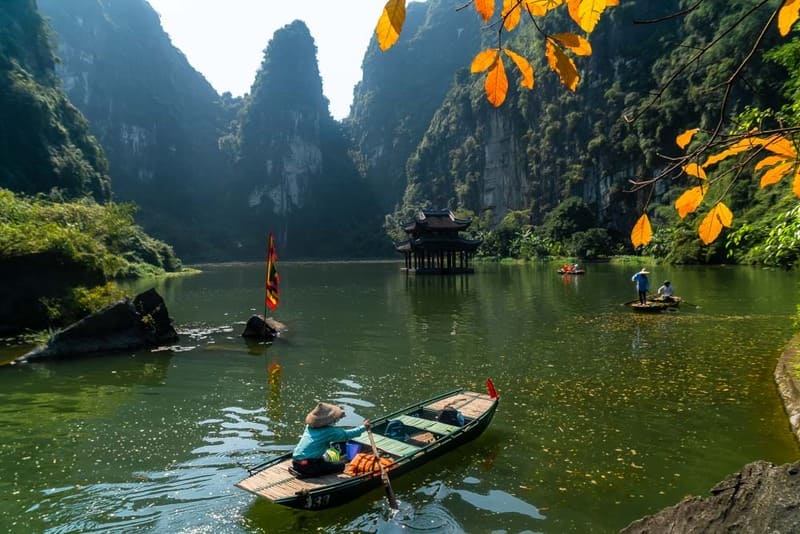
The Trang An Landscape Complex
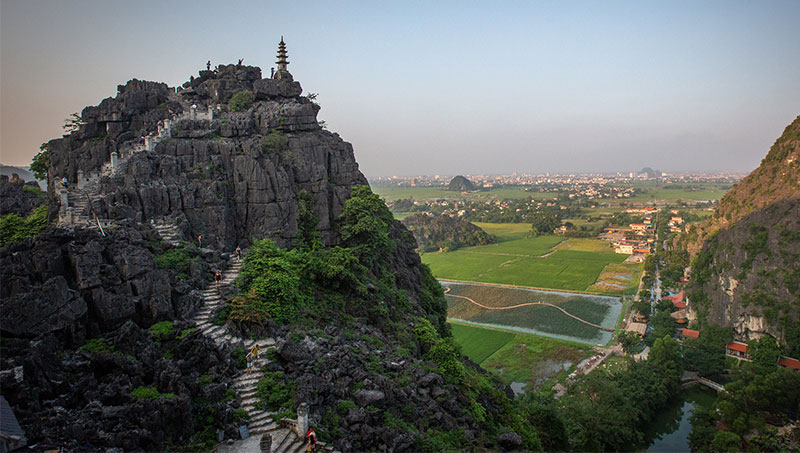
Mua Cave or Hang Mua
For a full picture of how these fit into one or two days, see our Ninh Binh guide.
FAQs
Is Bai Dinh suitable for older travelers or wheelchair users?
The new complex is manageable with the electric cart, which drops you close to the main halls, and the walkways between them are paved and mostly level. The stupa has a lift. What is not accessible is the ancient pagoda: 300 stone steps with no alternative route. Plan the lower complex for anyone with limited mobility and skip the climb.
Are English-speaking guides available at Bai Dinh?
Guides can be arranged on site for 500,000 VND per tour, though English availability varies by day. Bai Dinh is one of the places where a guide changes the visit, because almost nothing on the site is explained in English beyond the labels. Our own guides are English-speaking, and we build Bai Dinh into Ninh Binh itineraries with one included.
Where can you eat at Bai Dinh?
Thinly. There is a restaurant and a café near the entrance area, but options inside the complex are limited and mostly packaged snacks, which catches out visitors who spend four hours walking. Eat before you arrive, or plan lunch for after you leave, and carry water in.
What is the best time of day for photographs?
Early morning for the halls, when the light comes in low across the courtyards and the crowds have not arrived. Late afternoon from the top of the stupa, looking back over the complex towards the hills. Midday is the worst of both: hard light, and the heat that makes people rush.
What is the difference between a pagoda and a temple in Vietnam?
A pagoda, chùa, is a Buddhist place of worship with a main hall, monks' quarters and prayer spaces. A temple, đền, honours national heroes, emperors or local deities rather than the Buddha. Bai Dinh is a chùa; the two royal temples at Hoa Lu are đền. Vietnamese travelers use the distinction constantly, and it explains why the two sites feel so different.
Planning your visit
Come early or come at night, take the cart unless the weather is kind, and build in the climb to the caves. Bai Dinh punishes people who treat it as a stop between two other stops, and rewards the ones who give it a proper half day.







 Our team
 Our team
 Our team
 Our team




 Other
Other Add us as a preferred source