Mua Cave 101: 486 Steps, Two Viewpoints, One Decision
Mua Cave, or Hang Mua, is 486 stone steps up Ngoa Long Mountain to two viewpoints over Tam Coc's rice fields and the karst peaks around it. The cave itself isn't the main draw; the steps and the view from the top are why people come. Most visitors need about 1.5 to 2 hours, and the single biggest decision is what time of day you go, because the difference between an empty summit and a crowded one comes down almost entirely to timing.
One honest note before anything else: the cave the site is named after is barely visited. Almost everyone who comes here climbs straight past it for the view. This guide is built around that reality.
Written by Oliver PHUNG (Tour Guide)
Updated on Aug 24, 2026
0 comment
Oliver Phung is a Northern Vietnam-based tour guide and blogger. His favorite topics to write about include cuisine, culture, travel, and under-the-radar experiences. Oliver possesses a deep, detailed understanding of the region, from the indigenous culture of the Hmong in the Northwest to the highland lifestyle of the Tay in the Northeast. Whether he is exploring ancient architecture or geological landscapes, he is always eager to share his insights with his readers.
Beyond his work at Kampá Tour, he produces specialized travel content on platforms such as Reddit, Instagram, LinkedIn, and various other publications.
Steps: 486 to the top, officially. The mountain is 142 m high.
Entrance: 150,000 VND per person for adults and children over 1 m tall, free under 1 m. Cash only, no card machines on site.
Opening hours: 6:00 AM to 7:00 PM daily.
Time needed: 1.5 to 2 hours for both viewpoints, including rest stops.
Best time: before 8:00 AM. Sunset is popular for the wrong reason: it's when the mountain is most crowded, not when the light is best.
Not for: anyone with breathing or joint problems, and take extra care with children on the Dragon Peak side, which has no railing.
Update note: the 150,000 VND rate in this guide has applied since 1 April 2026. For ticket prices, opening hours and drone rules, always defer to the official notice at the site if anything has changed since.
Is Mua Cave worth the climb?
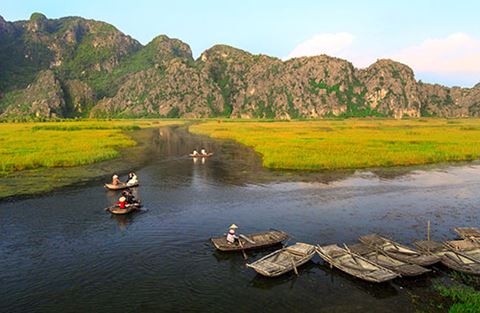
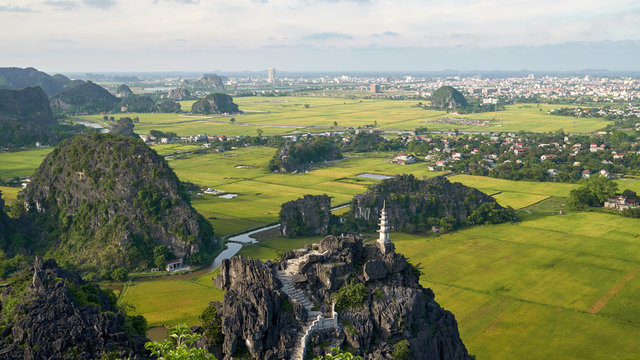
Yes, though the first ten minutes will not convince you of that. The lower stairs sit under tree cover, there is nothing to see yet, and all you notice is your own breathing. Then, somewhere past the halfway mark, the trees fall away and the whole valley appears at once: the Ngo Dong River cutting through the paddies, karst peaks standing over Tam Coc, and on a clear day most of Ninh Binh laid out below. It is a single reveal rather than a gradual one, which is part of why this photograph gets shared so often.
What it will not give you is solitude. The stairs are fully exposed, the heat builds fast even before nine in the morning, and by mid-morning on any weekend you are climbing in a line of people, not a quiet trail. Decide before you set off which matters more to you: the view, or the empty summit. Arriving early is the only way to get both.
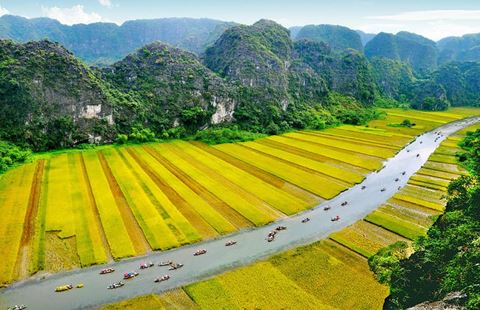
In the rice field season, the landscape becomes poetic
The parking, and how not to overpay
If you arrive by bike or motorbike, this is the one thing to know before the stairs. On the approach road, people will step out and wave you into a lot before the official entrance, insisting you have to park there. You do not.
⚠️ Parking, the correct price
Ignore anyone flagging you down before the main gate and continue to the official lot at the entrance. The going rate there is 5,000 VND for a bicycle and 10,000 VND for a motorbike. Anything asked above that is the unofficial rate, not the real one.
Two viewpoints, and they are not equally risky
The path splits about two-thirds of the way up, and the two sides are genuinely different experiences, not just two angles on the same view.
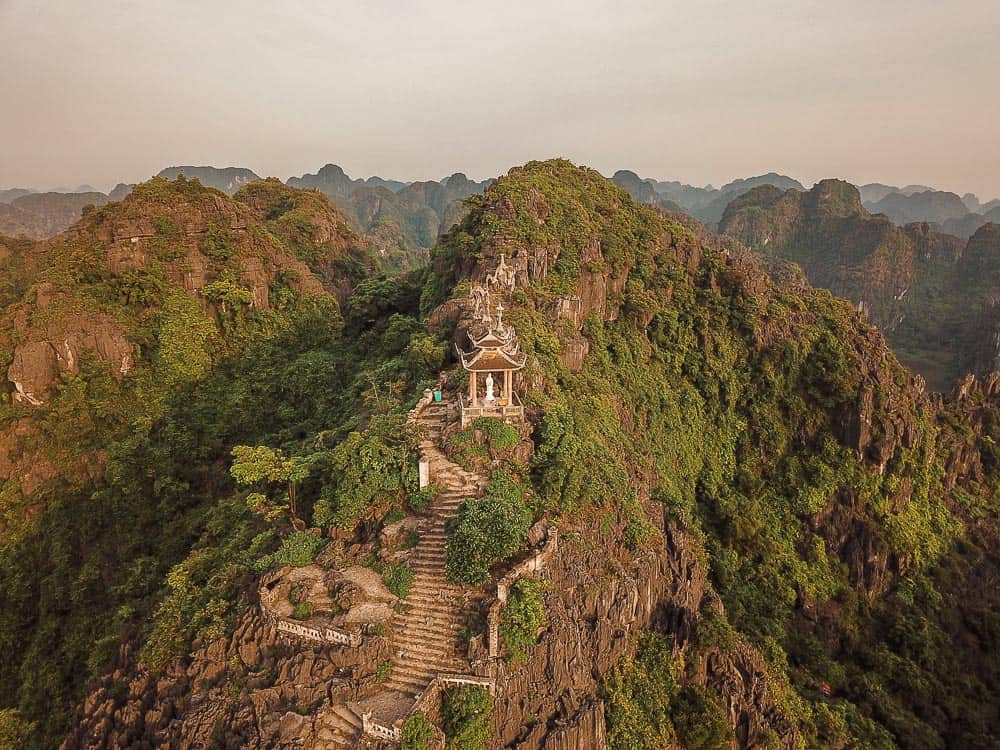
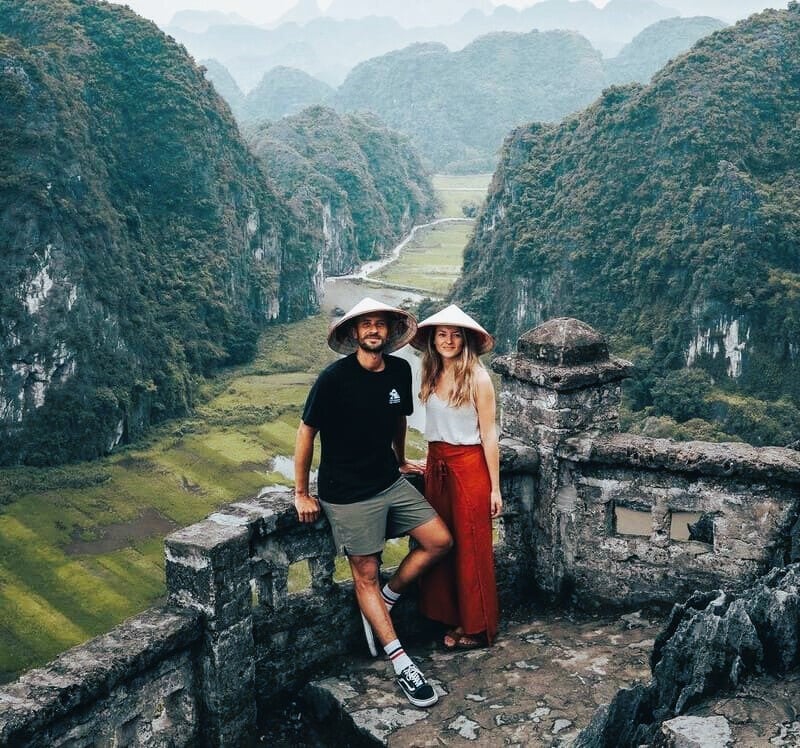
Dragon Peak, the higher point, ends on a narrow stone ridge with the carved dragon statue and a single chain as the only barrier on either side. The last stretch is more of a scramble than a walk, there is usually a queue just to stand beside the dragon for a photo, and it moves slowly. The 360° view from up there is the one in every Mua Cave photo, but if you are uneasy with heights, travelling with small children, or it has rained recently, this is the side to be careful with.
Pagoda Viewpoint, slightly lower, is calmer, has more space to stand, and gives you a clean photo of the dragon ridge from across the gap. It suits families, anyone short on nerve for exposed edges, and anyone who wants the view without the queue.
Criteria
Dragon Peak
Pagoda Viewpoint
View
Full 360° panorama, with the iconic dragon statue
A clear view of the dragon ridge from across the gap
Exposure
Higher; narrow ridge, a single chain as the barrier on the final stretch
Lower, with more room to stand
Crowds
Usually busier, often a queue for photos
Usually quieter
Best for
Anyone set on the highest point and the iconic photo
Families, anyone uneasy with heights, or a gentler view
Just after rain
Extra caution needed; slippery stone and an exposed final stretch
Still take care on wet steps, but far less exposed
The spectacular scenery is a well-deserved reward after the effort of the ascent
One thing worth knowing if your legs or your schedule are running short: there is a platform about a hundred steps before the true summit on the dragon side that already gives a full 360° view. Plenty of visitors stop there rather than pushing on to the ridge itself, and the photo is barely different.
The climb: what to expect
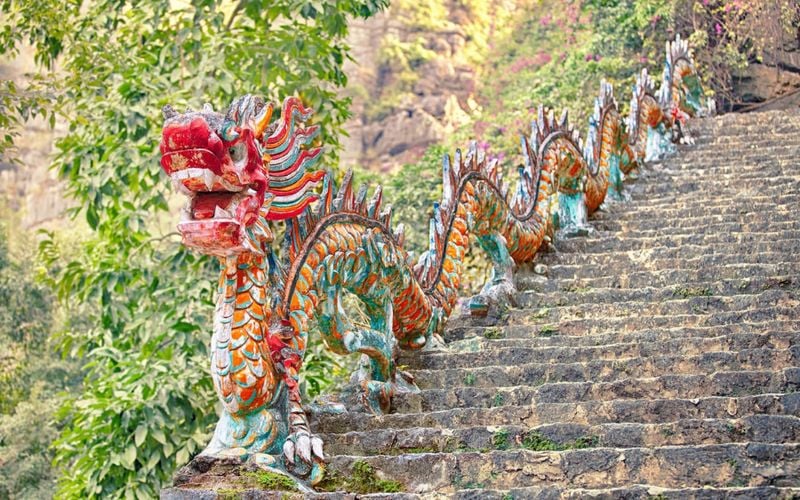
486 steps, carved with dragons and phoenixes
The ascent takes most people 30 to 45 minutes, with a handful of rest points along the way. The lower section is shaded by trees and gives you nothing to look at yet; the view only opens up in the second half, which is also where the steps get steeper and less even. Once the path steepens, keep your eyes on the stone rather than your phone: the unevenness catches people who look away for even a moment. Sturdy shoes matter here, not sandals, and wet after rain the stone gets properly slippery.
How the 486 steps unfold
The early stretch: more tree shade, no wide view yet. This is where to keep a steady pace rather than rush.
The second half: the view starts to open up, but the steps also get steeper and less even. This is where to watch your footing.
About two-thirds up: the path splits toward Dragon Peak and the pagoda side. If you are travelling with family or uneasy with heights, this is the moment to decide.
About 100 steps before Dragon Peak: a viewing platform already gives a full 360° panorama. A sensible place to stop if your legs are tired, your schedule is tight, or you'd rather not step onto the narrow ridge.
The final stretch to Dragon Peak: no longer an ordinary walk. It narrows, it's exposed, and you may have to wait for the person ahead of you to move.
The railings are carved with images of dragons, adding an artistic and symbolic touch to the climb to the cave
The highest view of Mua cave
Budget 1.5 to 2 hours in total for both viewpoints: about 40 minutes up, 20 to 30 minutes down, and the rest at the top for photos. Doing only one side, most people manage it in under an hour.
The cave itself, and what to do if you skip the climb
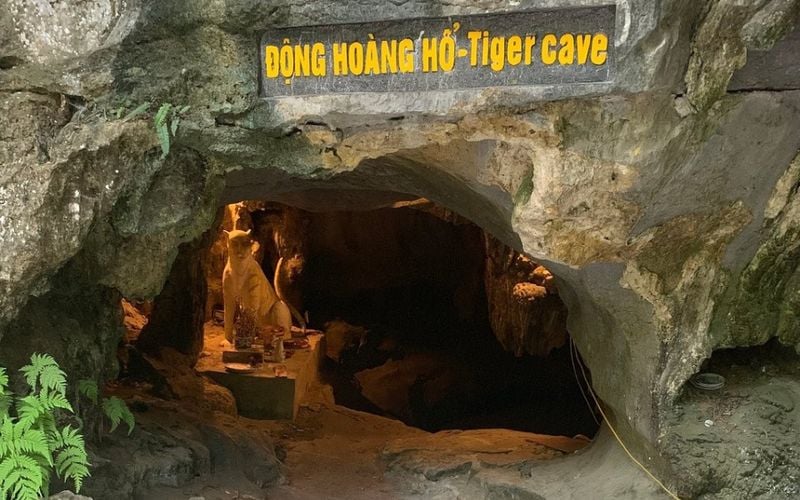
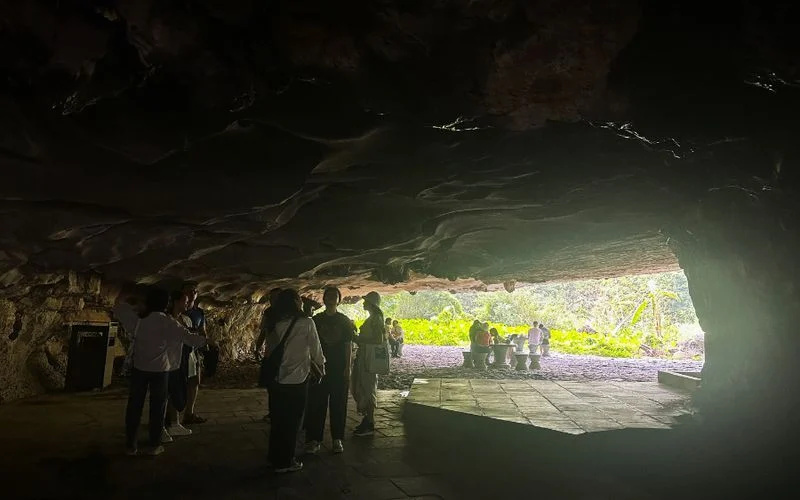
The cave the site is named after is a short passage that tunnels straight through the base of the mountain rather than ending in a dead end, cooler inside than out but not dramatic by Vietnamese cave standards. There are two of these small openings at the foot of the mountain, one along the path up and one just left of the entrance. Historically, this area also served as a shelter for wounded soldiers during Vietnam's resistance wars, a piece of history most visitors walk straight past.
If climbing 486 steps is not for you, or not for everyone in your group, that does not mean an empty visit. A series of boardwalks winds through the rice fields at ground level, and it is one of the quietest corners of the whole site, since almost everyone else is on the stairs. An hour spent here, camera in hand, is a perfectly good way to experience Mua Cave without a single step.
If you don't want to reach the top, where to stop
Uneasy with heights or travelling with young children: head for the Pagoda Viewpoint side.
Legs tired but still want the panorama: stop at the 360° platform below Dragon Peak.
Climbing isn't for you: spend your time on the rice-field boardwalks, the two small caves, and the lotus pond at the base instead.
It has just rained: consider skipping the Dragon Peak ridge, since the stone there gets slipperier than usual.
The Tiger Cave is located at the foot of Ngoa Long Mountain
The natural cave is to the left of the entrance path to Hang Mua
The lotus pond
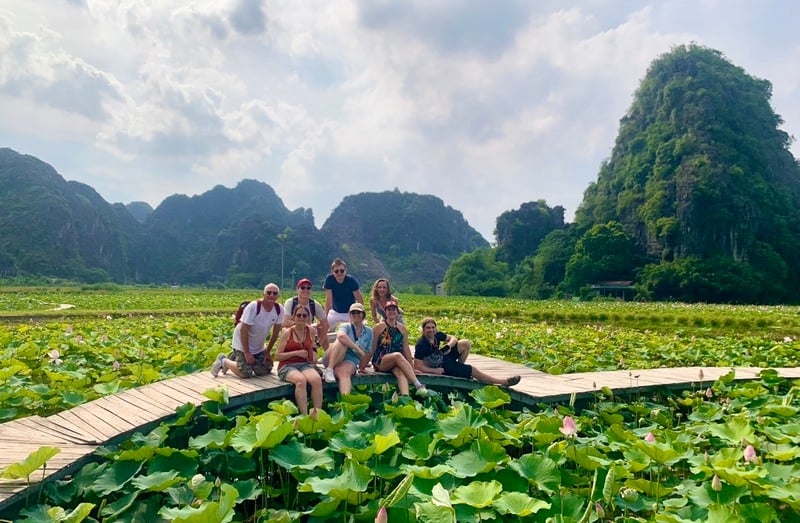
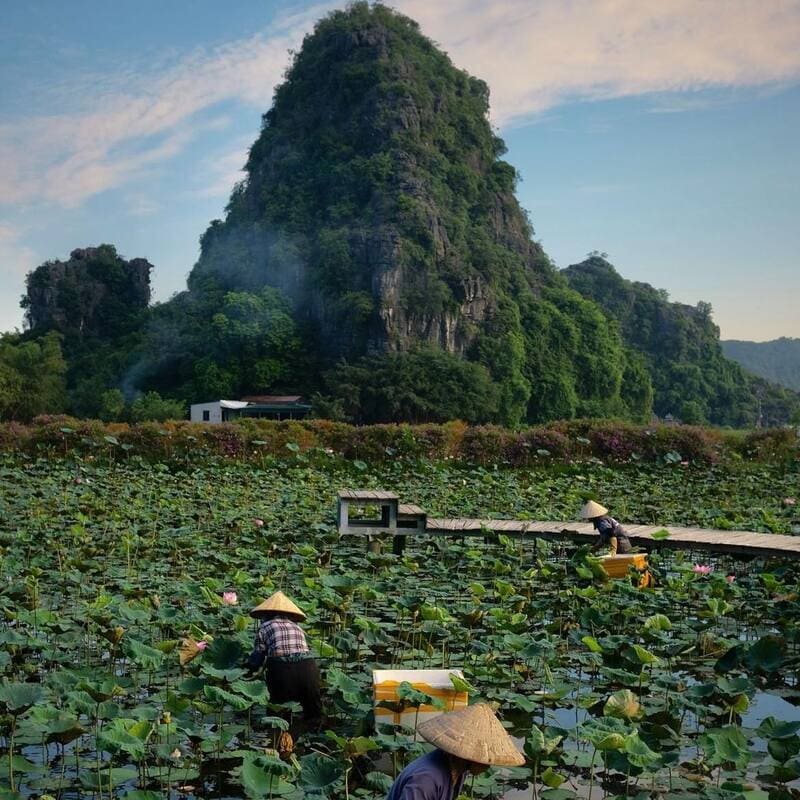
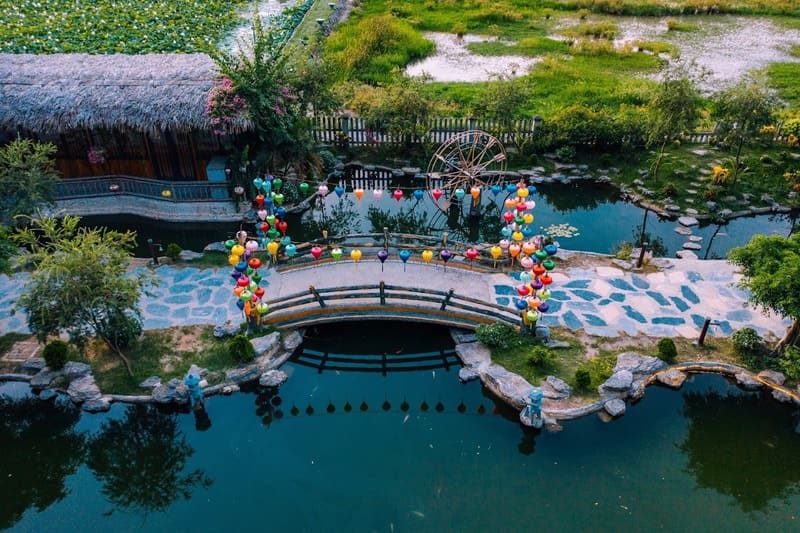
Right by the entrance, a pond of nearly one hectare fills with pink and white lotus from May to July. Mornings are best, when the flowers are fully open. A bamboo bridge crosses the pond for photos, and áo dài rental is available on site if you want the classic shot.
Our travelers visit Ninh Binh during the lotus flower season
Lotus flower is not only present in daily life, but it is also linked to national history, appearing in the poetry, music, painting and architecture of Vietnam
Go before 8:00 AM if you can. This matters more here than at most Ninh Binh sights, because the climb is fully exposed and the summit is small. Arrive within an hour of opening and you may have the ridge nearly to yourself; arrive after 10:00 AM and you are climbing alongside tour buses in the heat.
💡 Oliver's advice
Sunset is the time most guides recommend, and the light can be beautiful. But it is also the busiest window of the day, when the narrow dragon ridge fills up and moving, let alone photographing anything, gets difficult. If a quiet view matters more to you than a golden one, sunrise wins by a wide margin. Guests staying at Hang Mua Ecolodge, right at the foot of the mountain, get free and unlimited access and can climb before the public gate opens, which is the most reliable way to have the summit to yourself.
By season, October to April is the most comfortable stretch for the climb itself: cooler, less humid, with the clearest skies from October to December. May and June bring the golden rice harvest around the base, the single most photographed backdrop in Ninh Binh, though the heat and humidity by then are considerable. Whatever the season, keep your ticket after buying it: staff sometimes check again before the climb begins.
Hang Mua means "Dancing Cave": hang is cave, múa is dance. According to legend, King Tran Thai Tong, in the 13th century after moving the capital back to Hoa Lu, would visit this cave at the foot of the mountain to watch his court's dancers and singers perform. The name stuck.
Hang Mua today is a top destination in Ninh Binh
What to wear and bring
Shoes: closed, sturdy footwear. The stone is uneven and slippery when wet.
Water: bring your own. Shade is limited on the climb.
Cash: for the ticket, parking, and anything at the stalls near the entrance. There is no card payment on site.
On the dragon ridge: keep a safe distance when posing. There is no railing and the space is narrow, especially when it is busy.
Note: the climb is not recommended for anyone with breathing or joint problems, or for elderly travelers with limited mobility. Pack light, wear something you can move in, and carry your rubbish back down with you.
Where is Mua Cave?
Mua Cave sits in Khe Dau Ha, Ninh Xuan commune, Hoa Lu district, Ninh Binh province, at the foot of Ngoa Long Mountain and within the Trang An landscape. It's about 10 km from Ninh Binh city, and just over 90 km south of Hanoi, usually around a 2-hour drive.
Tam Coc sits close by, which is why the two are so often combined in one day. The thing that matters for planning isn't cramming in more stops, but giving Mua Cave the full 1.5 to 2 hours it needs, rather than turning the climb into a race against the clock.
Getting to Mua Cave
The right choice depends on whether convenience, cost, or flexibility matters more to you. For a first visit where you'd rather not sort out transport yourself, a tour from Hanoi is the simplest option; to save money, the train or bus gets you to Ninh Binh, then a taxi or Grab covers the rest.
Tour from Hanoi: the simplest option for a first visit. Round-trip transport, an English-speaking guide, and entrance included, often combined with Tam Coc or Hoa Lu. About 2 to 2.5 hours each way, from $40 to $60 USD per person.
Train: Hanoi to Ninh Binh in 1.5 to 2 hours ($3 to $5), then a taxi or Grab the remaining 10 km (around $4 to $6).
Bus or limousine: 2 to 2.5 hours from Giap Bat or My Dinh stations, $4 to $6 by bus or $10 to $12 for a more comfortable limousine service.
You do not need to stay near Mua Cave to visit it. Most travelers base themselves in Tam Coc, a short ride away, and come here for a few hours.
What to combine with Mua Cave
One realistic warning first: Mua Cave alone takes 1.5 to 2 hours, so fitting it into a tight afternoon alongside a boat tour and a pagoda is optimistic. If your day is already full, do the climb in the morning and keep the rest light.
A scenic boat ride through three natural caves and open rice paddies along the Ngo Dong River, often called "Ha Long Bay on land". The natural follow-on after the climb.
A longer, more varied boat route through caves, grottoes and temples across the limestone valleys. Choose this over Tam Coc if you want more time on the water.
Vietnam's 10th-century capital, with the temples of Kings Dinh and Le. Flat ground throughout, a good pairing if you want history without another climb.
Thung Nham Bird Garden (12 km away)
A quiet wetland where thousands of storks and herons return to roost at sunset, best visited late in the day.
Three ways to build the day without overloading it
Half day: Mua Cave early, then on to Tam Coc. The tight option if the climb and a boat ride are your main goals.
A scenery-focused day: Mua Cave before the heat, then pick one of Tam Coc or Trang An rather than trying to fit in both.
A day that balances scenery and history: Mua Cave in the morning, Hoa Lu Ancient Capital for the rest of the day; add something lighter like Bich Dong only if you still have the energy and time.
Simple rule: if Mua Cave is the priority, put it first. The climb is more pleasant, and you won't have to cut your time at the top short to make it to the next stop.
You don't need to sleep right beside Mua Cave. For most travelers, where you stay should come down to what you want to prioritize the next morning.
Where to stay
Best if...
What to know
Tam Coc
You want a convenient base to combine Mua Cave with nearby sights
Most travelers stay here and make the short trip to Mua Cave
Right at the foot of Mua Cave
Sunrise or an empty summit is your top priority
Hang Mua Ecolodge gives free, unlimited access and lets you climb before the public gate opens
If sunrise isn't a special priority, Tam Coc is usually the more balanced choice for your overall itinerary. If getting up the mountain early is the main goal, staying right at the foot of Mua Cave has a clear edge.
Hang Múa Ecolodge
Hang Mua Ecolodge sits right at the foot of the mountain. Staying here is the only reliable way to climb before the public gate opens, since guests get free and unlimited access to the viewpoint, which matters if sunrise or an empty summit is the priority.
For other areas and specific properties around Tam Coc and Trang An, see our guide to the best hotels in Ninh Binh.
You need to contact and get permission from the site management before flying. It is not a free-for-all, and it is not outright banned either, so check with staff at the entrance before you plan a shoot around it.
Is Mua Cave safe for children?
The Pagoda Viewpoint side is manageable for older children with supervision. The Dragon Peak side is a different matter: the final stretch is a scramble with a single chain as the only barrier, and several visitors specifically advise against it with young children. If you are unsure, take the pagoda side, stop at the 360° platform below the dragon summit, or spend the time on the rice-field boardwalks at ground level instead.
Can elderly travelers do the climb?
It depends on fitness rather than age alone; travelers in their 60s manage it regularly. That said, it is not recommended for anyone with breathing or joint problems, and the steps are uneven with no handrail for most of the route. If in doubt, the Pagoda side is shorter and gentler than the Dragon side.
When is lotus season at Mua Cave?
May to July, with flowers fullest and most open in the early morning. The pond sits right by the entrance, so it is easy to see even if you skip the climb.
Do I need to book a ticket in advance?
No. Tickets are sold at the gate, cash only. There is no online booking and no card payment on site, so bring enough cash for the ticket and parking.
How much is the Mua Cave entrance ticket?
150,000 VND per person for anyone over 1 m tall, adults and children alike; free under 1 m. This rate took effect on 1 April 2026, up from 100,000 VND before that, so many older guides and blog posts online still quote the previous price.
Planning your visit
Arrive early, wear proper shoes, and decide before you reach the fork whether the dragon ridge or the quieter pagoda side suits your group better. That one decision, more than anything else, shapes how the visit feels.
To make your journey easier, our tours include an English-speaking guide, private transport, and can combine Mua Cave with Tam Coc, Trang An or Hoa Lu into one well-paced day. Contact us to design a personalized itinerary around it.
Planning your trip?
Save time and get expert advice for FREE!
✅ 15 years of local experience
✅ Save up to 40 hours of planning
✅ Travel stress-free from start to finish
Book your free consultation today!





 Our team
 Our team
 Our team
 Our team

.jpg)
.jpg)



 Other
Other Add us as a preferred source