Vietnam Airports Guide: Which Airport Should You Fly Into?
Vietnam is a hot spot for travelers, drawing in crowds year-round with its captivating charm. For those gearing up to explore Vietnam, the journey typically kicks off at one of the country's airports. Thus, picking the perfect airport, be it international or domestic, sets the tone for an unforgettable adventure.
But just how many airports does Vietnam boast? And which airlines should you consider? This article delves into Vietnam's airport landscape, offering insights to aid adventurers in selecting the optimal launchpad for their journey.
Written by Oliver PHUNG (Tour Guide)
Updated on Aug 06, 2026
3 comments
Oliver Phung is a Northern Vietnam-based tour guide and blogger. His favorite topics to write about include cuisine, culture, travel, and under-the-radar experiences. Oliver possesses a deep, detailed understanding of the region, from the indigenous culture of the Hmong in the Northwest to the highland lifestyle of the Tay in the Northeast. Whether he is exploring ancient architecture or geological landscapes, he is always eager to share his insights with his readers.
Beyond his work at Kampá Tour, he produces specialized travel content on platforms such as Reddit, Instagram, LinkedIn, and various other publications.
If it is your first trip to Vietnam, choose your arrival airport according to your itinerary, not only the cheapest flight.
Fly to Hanoi (HAN) if your trip starts in northern Vietnam, including Hanoi, Ninh Binh, Ha Long Bay, Sapa or Ha Giang.
Fly to Da Nang (DAD) if you plan to visit central Vietnam, especially Da Nang, Hoi An or Hue.
Fly to Ho Chi Minh City (SGN) if your trip focuses on southern Vietnam, the Mekong Delta, Cu Chi Tunnels, Mui Ne or a connection to Phu Quoc.
Fly to Phu Quoc (PQC) or Cam Ranh (CXR) if your main goal is a beach holiday in Phu Quoc or Nha Trang.
For a classic first-time Vietnam route, the easiest option is often to fly into Hanoi and fly out of Ho Chi Minh City, or the reverse. This helps you avoid unnecessary backtracking across the country.
Vietnam Airports at a Glance
Vietnam has 22 civilian airports in operation, including 12 international airports and 10 domestic airports. For most international travelers, the three most important arrival airports are:
Noi Bai International Airport (HAN) in Hanoi, ideal for northern Vietnam,
Da Nang International Airport (DAD) in central Vietnam, ideal for Da Nang, Hoi An and Hue,
Tan Son Nhat International Airport (SGN) in Ho Chi Minh City, ideal for southern Vietnam.
Other international airports also serve popular destinations such as Nha Trang, Phu Quoc, Da Lat and the Mekong Delta. In practice, the best airport for your trip depends less on the airport itself and more on your itinerary: northern, central or southern Vietnam.
Vietnam Airport Map
Map of major airports in Vietnam, from northern to southern regions - Image source: hptoancau
Vietnam’s main domestic airlines include Vietnam Airlines, Vietjet Air, Bamboo Airways and Vietravel Airlines. Flight schedules, routes and baggage rules may change, so travelers should always check the airline’s official website before booking.
If you plan to travel during Vietnamese public holidays or peak travel seasons, it is better to book flights in advance and recheck your flight schedule before departure.
Main Vietnam Airports for International Travelers
Hanoi Airport - Noi Bai International Airport (HAN): Best for Northern Vietnam
Official name: Noi Bai International Airport
Address:Noi Bai International Airport is located in Soc Son District, about 30 km from Hanoi Old Quarter / central Hanoi. The drive usually takes 45 minutes to 1 hour, depending on traffic.
Noi Bai International Airport is the main airport serving Hanoi and the main international gateway for travelers visiting northern Vietnam. It is a practical choice if your trip begins in Hanoi or includes destinations such as Ninh Binh, Ha Long Bay, Sapa, Ha Giang or Mai Chau.
For many first-time visitors, Hanoi is a natural starting point for a Vietnam itinerary, especially before heading to the mountains, Ninh Binh or Ha Long Bay.
Noi Bai International Airport (Hanoi)
The 2 terminals at Noi Bai Airport
Noi Bai Airport has two main passenger terminals:
Terminal 1: Domestic flights, used by airlines such as Vietnam Airlines, Vietjet Air, Bamboo Airways and other domestic carriers.
Terminal 2: International flights, serving Vietnam Airlines and many international airlines.
The two terminals are connected by a shuttle bus. If you need to transfer between domestic and international flights, allow around 15-20 minutes just to move between terminals, plus enough time for check-in, security and immigration procedures.
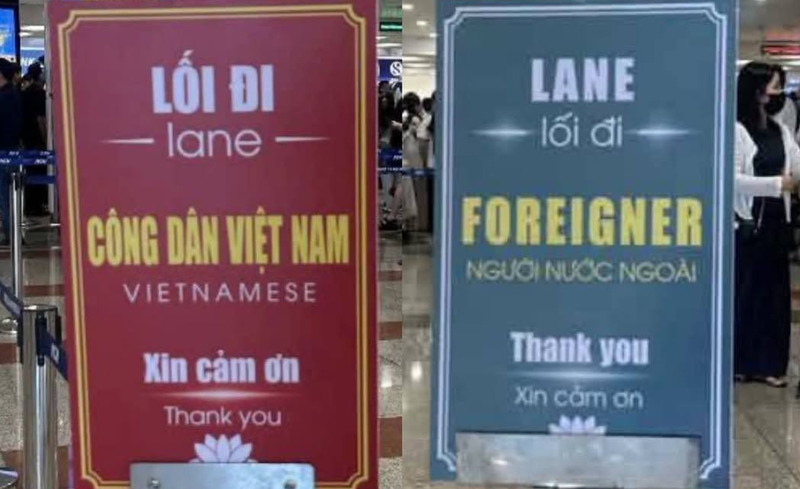
New arrival arrangement: At Terminal 2, Vietnamese citizens and foreign travelers now use separate immigration lanes. Foreign visitors should follow the signs marked “Foreigner” when approaching passport control.
Flights from Noi Bai Airport
Noi Bai Airport serves both domestic and international routes. From Hanoi, travelers can connect to most major destinations in Vietnam, including Da Nang, Hue, Ho Chi Minh City, Nha Trang, Da Lat and Phu Quoc, depending on the airline schedule.
For international travelers, Noi Bai is especially convenient if Vietnam is the first stop of a north-to-south itinerary, or if the trip focuses mainly on northern Vietnam.
Useful Services at Noi Bai Airport
Noi Bai Airport offers the main services travelers usually need on arrival or before departure:
Free Wi-Fi: Available in the terminals.
ATMs and currency exchange: Available in both domestic and international terminals.
Vietnam SIM card counters: Especially useful for international arrivals at Terminal 2.
Sleeping cabins: A practical option for long layovers or early departures.
Lounges, restaurants and shops: Available in passenger areas.
Luggage services: Including luggage packing and storage services.
Family facilities: Children’s areas are available in selected zones.
Terminal shuttle: Connecting the domestic and international terminals.
Service locations and opening hours may change, so it is best to check airport signs or ask the information desk when you arrive.
Sleeping cabins at Noi Bai International Airport
How to Get from Noi Bai Airport to Hanoi City Center
Noi Bai Airport is located outside the city, so the journey to Hanoi city center usually takes around 45 minutes to 1 hour, depending on traffic.
Option
Best for
Note
Taxi
Travelers who want a direct ride
Use official airport taxis or reliable taxi brands to avoid overcharging.
Grab
Travelers familiar with ride-hailing apps
Convenient, but pick-up points may vary and cars may take time to arrive.
Bus 86
Budget travelers
A low-cost option to central Hanoi, but less convenient with large luggage.
Private transfer
Families, couples, late arrivals or first-time visitors
The most comfortable option after a long international flight.
With Kampá Tour, your airport transfer can be arranged in advance, so you can meet your driver after arrival and avoid negotiating taxi prices at the airport.
💡 Noi Bai Airport is the best starting point if your journey begins in northern Vietnam, especially Hanoi, Ninh Binh, Ha Long Bay, Sapa, Ha Giang or Mai Chau.
Hanoi, the capital is full of poetic and traditional beauty
Tan Son Nhat International Airport (Ho Chi Minh City)
Tan Son Nhat International Airport is the main airport serving Ho Chi Minh City and the most convenient gateway for travelers visiting southern Vietnam. It is a practical choice if your trip starts in Ho Chi Minh City or includes the Cu Chi Tunnels, the Mekong Delta, Mui Ne, Con Dao or a domestic connection to Phu Quoc.
For many travelers following a north-to-south Vietnam itinerary, Ho Chi Minh City is also a logical final stop before taking an international flight home or continuing to another Southeast Asian country.
The 3 terminals at Tan Son Nhat Airport
Since 2025, Tan Son Nhat Airport has had three main terminals:
Terminal 1: Domestic flights operated by several Vietnamese carriers.
Terminal 2: International flights.
Terminal 3: Terminal 3 is the new domestic terminal. Since May 17, 2025, Vietnam Airlines has moved its domestic flights at Tan Son Nhat Airport to Terminal 3, except for flights to Con Dao, Rach Gia and Ca Mau. Pacific Airlines and VASCO continue to operate from Terminal 1.
The transfer time between terminals can take around 15-20 minutes, depending on traffic inside the airport area and the terminal you need. Free shuttle buses connect Terminals 1, 2 and 3, but travelers should allow extra time because the terminals are separate.
Flights from Tan Son Nhat Airport
Tan Son Nhat Airport serves both domestic and international routes. From Ho Chi Minh City, travelers can connect to most major destinations in Vietnam, including Hanoi, Da Nang, Hue, Nha Trang, Da Lat, Phu Quoc and other regional airports, depending on the airline schedule.
Internationally, SGN is one of Vietnam’s busiest gateways and offers many connections within Asia and beyond. For travelers visiting southern Vietnam, it is usually the most practical arrival or departure airport.
Useful Services at Tan Son Nhat Airport
Tan Son Nhat Airport offers the main services travelers usually need on arrival or before departure:
Free Wi-Fi: Available in the terminals.
ATMs and currency exchange: Available in passenger areas, especially around the international terminal.
Vietnam SIM card counters: Useful for international arrivals who need mobile data immediately.
Nap pods: A practical option for long layovers or late-night departures.
Lounges: VIP and CIP lounges are available in domestic and international terminals.
Luggage services: Including luggage packing and luggage storage.
Shops and restaurants: Available before and after security.
Medical services: Available inside the airport.
Service locations and opening hours may change, so it is best to follow airport signs or ask the information desk when you arrive.
VIP lounges at Tan Son Nhat Airport
How to Get from Tan Son Nhat Airport to Ho Chi Minh City Center
Tan Son Nhat Airport is close to the city center, but traffic in Ho Chi Minh City can be heavy. The ride to central areas such as District 1 usually takes around 30 minutes, but it can take longer during rush hour.
Option
Best for
Note
Taxi
Travelers who want a direct ride
Use official taxi brands such as Mai Linh or Vinasun, or book through airport taxi counters.
Grab
Travelers familiar with ride-hailing apps
Convenient, but make sure you go to the correct app-based pick-up point.
Bus 109
Budget travelers
A low-cost option to the city center, but less convenient with large luggage or after a long flight.
Private transfer
Families, couples, late arrivals or first-time visitors
The most comfortable and stress-free option, especially after an international flight.
For most first-time visitors, taxi, Grab or a pre-arranged private transfer is easier than public buses, especially after a long international flight.
With Kampá Tour, your airport transfer can be arranged in advance, so you can meet your driver after arrival and avoid negotiating taxi prices at the airport.
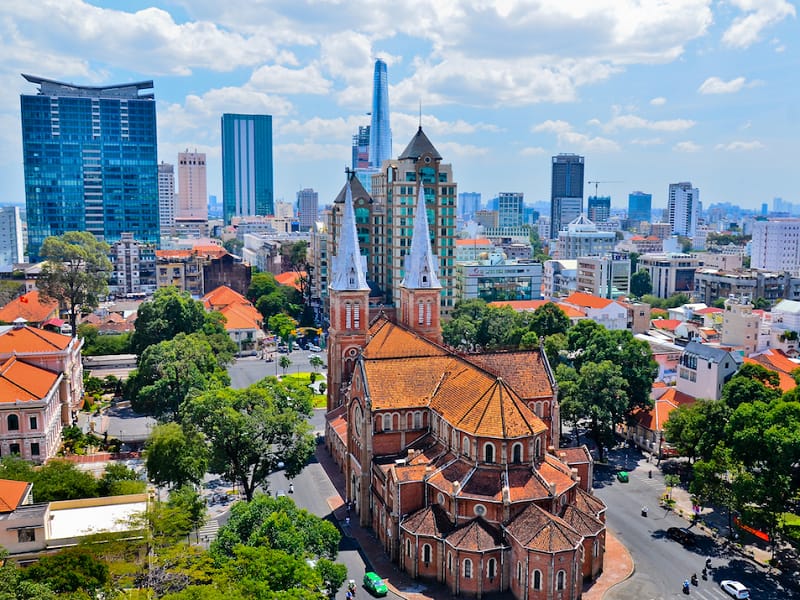
Ho Chi Minh City, Vietnam's largest city, located in the south
💡 Tan Son Nhat Airport works best for southern Vietnam itineraries, including Ho Chi Minh City, Cu Chi, the Mekong Delta, Mui Ne, Con Dao or a domestic connection to Phu Quoc.
▶️💥 Important things to know when traveling by plane in Vietnam:
From February 26, 2025, external batteries will be banned from use on the airplanes of Vietnam Airlines and VietJet – Vietnam's two most famous airlines. Here is what passengers must keep in mind:
❌Power banks are allowed only in carry-on baggage and must not be used or charged during the flight. Keep them visible and easily accessible, and always check the latest airline rules before boarding.
❌ Connecting the external battery to anything is prohibited.
❌ Charging devices with an external battery is prohibited.
❌ For batteries in the range of 100 to 160Wh, only 2 batteries are allowed per passenger.
This new measure is undertaken as part of enhanced safety regulations on board aircraft, in order to guard against any risk of fire from lithium batteries. If traveling with Vietnam Airlines or VietJet, consult the regulations before boarding to avoid any problems at the airport.
Other Useful Airports in Vietnam for Tourists
Besides Hanoi and Ho Chi Minh City, several other airports in Vietnam are useful for travelers, especially if your itinerary focuses on central Vietnam, beach destinations or the Mekong Delta. Among them, Da Nang Airport (DAD) is particularly important, as it is one of the main gateways for international visitors traveling to central Vietnam.
Da Nang Airport (DAD): Best for Hoi An, Hue and Central Vietnam
Address: Nguyen Van Linh Street, Hoa Thuan Tay Ward, Hai Chau District, Da Nang City
Distance from city center: Da Nang Airport is about 3–5 km from the city center, depending on the exact destination.
Airport code: DAD
Da Nang Airport is the most convenient airport for travelers visiting central Vietnam. It is the best arrival point for Da Nang city, Hoi An, Ba Na Hills and, in many itineraries, Hue. If your Vietnam trip focuses on the central coast, DAD is usually a better choice than flying into Hanoi or Ho Chi Minh City and taking a long domestic transfer.
💡 Da Nang Airport is the most practical choice for Hoi An, Da Nang, Hue, Ba Na Hills and the central coast of Vietnam.
Cam Ranh Airport (CXR): Best for Nha Trang
Address: Nguyen Tat Thanh Street, Cam Ranh, Khanh Hoa Province
Airport code: CXR
Cam Ranh Airport is commonly used by travelers visiting Nha Trang and nearby beach resorts. Although many visitors search for “Nha Trang Airport,” the airport code CXR actually refers to Cam Ranh Airport.
💡 For Nha Trang and nearby beach resorts, Cam Ranh Airport is the airport you should look for when booking your flight.
Hue Airport (HUI): Best for Hue
Address: National Road 1A, Phu Bai area, Huong Thuy, Thua Thien Hue Province
Distance from city center: About 15 km
Airport code: HUI
Hue Airport is convenient if you only plan to visit Hue. However, many international travelers still fly into Da Nang Airport because it offers more flight options and works well for combined Hue - Da Nang - Hoi An itineraries.
💡 Hue Airport is convenient for a Hue-focused trip, but Da Nang often offers more flight options for a combined Hue - Da Nang - Hoi An itinerary.
Da Lat Airport (DLI): Best for Da Lat and the Central Highlands
Address: National Road 20, Lien Nghia Town, Duc Trong District, Lam Dong Province
Distance from city center: About 28 km
Airport code: DLI
Da Lat Airport, also known as Lien Khuong Airport, is the most convenient airport for travelers visiting Da Lat. For wider Central Highlands itineraries, Buon Ma Thuot Airport may also be useful depending on the route.
💡 Da Lat Airport is ideal if you want to go straight to Da Lat, while Buon Ma Thuot may be more useful for some wider Central Highlands routes.
Phu Quoc Airport (PQC): Best for Phu Quoc Island
Address: Duong To Commune, Phu Quoc, Kien Giang Province
Distance from city center: About 15 km
Airport code: PQC
Phu Quoc Airport is the main gateway to Phu Quoc Island, one of Vietnam’s most popular beach destinations. It is usually reached by domestic flights from Hanoi, Ho Chi Minh City or Da Nang, depending on the season and airline schedule.
💡 Phu Quoc Airport is the easiest arrival point for a beach stay on Phu Quoc Island.
Can Tho Airport (VCA): Useful for the Mekong Delta
Address: 179B Le Hong Phong Street, Tra An Ward, Binh Thuy District, Can Tho City
Distance from city center: About 8 km
Airport code: VCA
Can Tho Airport can be useful for travelers going directly to the Mekong Delta. However, most international visitors still enter southern Vietnam via Ho Chi Minh City because Tan Son Nhat Airport offers more flight options and easier international connections.
💡 Can Tho Airport can save time for some Mekong Delta routes, although most international visitors still arrive via Ho Chi Minh City because of better flight connections.
Vietnam Airport Codes You Should Know
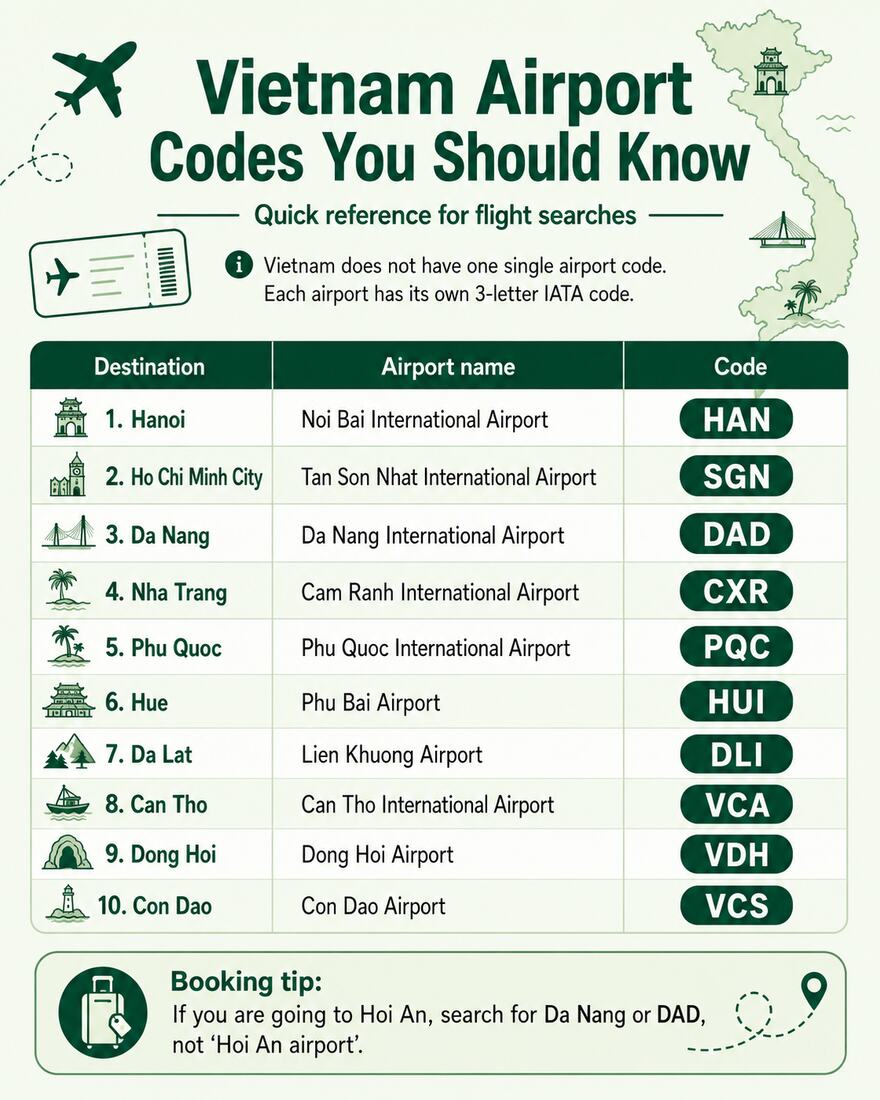
Many travelers search for “Vietnam airport code”, but Vietnam does not have one single airport code. Each airport has its own three-letter IATA code, which is the code you will usually see when booking flights, checking boarding passes or searching airline schedules.
Here are the most useful Vietnam airport codes for travelers:
Quick reference guide to the main airport codes in Vietnam, including HAN, SGN, DAD, CXR, PQC and other useful codes for travelers.
When booking flights, search by both the destination name and the airport code. This is especially useful for places that do not have their own airport. For example, if you are going to Hoi An, search for Da Nang or DAD, not “Hoi An airport”.
Common Airport Mistakes When Planning a Vietnam Trip
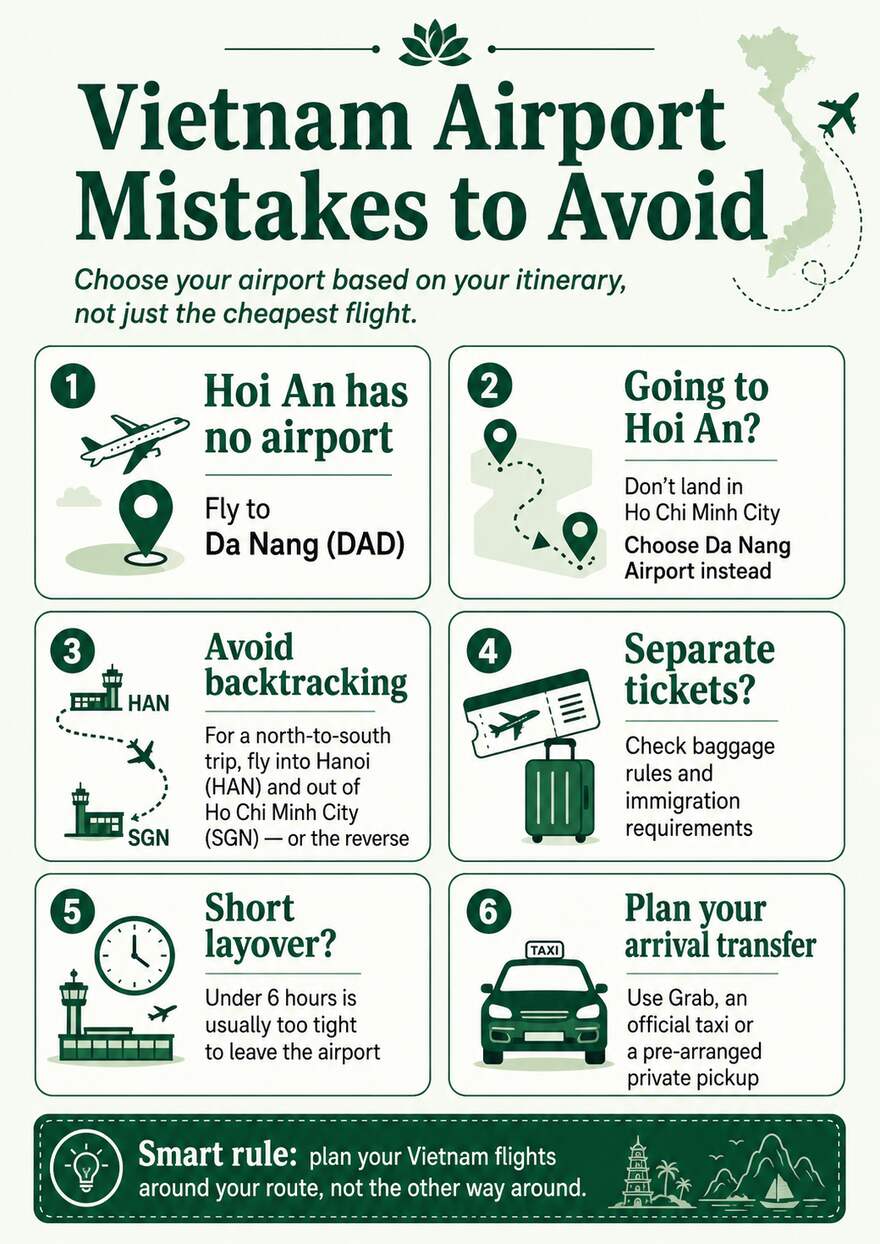
Choosing the right airport in Vietnam is not only about finding the cheapest flight. A small airport mistake can add an unnecessary domestic flight, a long transfer or a stressful connection day. Here are the most common mistakes travelers should avoid when planning a Vietnam itinerary.
Mistake
Better choice
Why it matters
Flying into Ho Chi Minh City for Hoi An
Fly into Da Nang Airport (DAD) instead.
Da Nang is the closest major airport to Hoi An. Flying into Ho Chi Minh City means you will still need another domestic flight or a much longer journey.
Searching for “Hoi An airport”
Search for Da Nang Airport (DAD).
Hoi An does not have its own airport. Da Nang Airport is the standard arrival point for Hoi An, Da Nang and many central Vietnam itineraries.
Booking a round-trip flight from Hanoi when your trip ends in the south
Consider flying into Hanoi (HAN) and flying out of Ho Chi Minh City (SGN), or the reverse.
Vietnam is a long country. An open-jaw flight can help you avoid backtracking and save one domestic flight at the end of the trip.
Choosing Hue Airport without checking Da Nang flights
Compare both Hue Airport (HUI) and Da Nang Airport (DAD).
Hue Airport is convenient for a Hue-only stay, but Da Nang often offers more flight options for a combined Hue - Da Nang - Hoi An route.
Assuming separate tickets work like one connected flight
Check whether your baggage is checked through and whether you need to pass immigration.
With separate tickets, you may need to collect luggage, enter Vietnam and check in again. This requires more time and sometimes a visa or visa exemption.
Thinking your layover time is your real free time
Subtract immigration, baggage, airport transfer, check-in, security and boarding time first.
A 6-hour layover does not mean 6 hours in the city. In many cases, staying at the airport is safer than rushing outside.
Leaving the airport during a short layover
Stay inside the airport if your layover is under 6 hours.
Immigration, traffic, luggage and security can take longer than expected, especially in Hanoi or Ho Chi Minh City.
Booking domestic connections too close together
Leave enough time between flights, especially at HAN and SGN.
Major airports can be busy, terminals may be separate, and domestic flight times can change. A tight connection can easily become stressful.
Forgetting to check the departure terminal
Check your terminal before leaving for the airport.
This is especially important in Hanoi and Ho Chi Minh City, where domestic and international flights may use different terminals.
Accepting random taxi offers outside the airport
Use official taxi counters, trusted taxi brands, Grab or a pre-arranged private transfer.
Airport arrival areas can be confusing after a long flight. Having a clear transfer plan helps you avoid overcharging or getting into the wrong car.
Relying on airport services only after arrival
Prepare your SIM card, cash and transfer plan in advance when possible.
SIM card counters, currency exchange and transport options are available at major airports, but comparing everything on arrival can be tiring, especially after an international flight.
Packing power banks, lithium batteries or drone batteries incorrectly
Keep batteries in carry-on luggage and check your airline’s latest battery rules before flying.
Lithium batteries are subject to airline safety rules. Packing them incorrectly can cause delays at security or check-in.
In general, plan your Vietnam flights around your itinerary, not the other way around. For a first trip, the simplest route is often to start in one region and depart from another, such as Hanoi to Ho Chi Minh City, instead of returning to the same airport.
Da Nang International Airport
Useful Domestic Airports in Vietnam
Besides the main international airports, Vietnam also has several domestic airports that can be useful if you want to reach specific regions faster. These airports are especially helpful for destinations such as Phong Nha, the Central Highlands, Con Dao or the far south of Vietnam.
Airport
Code
Best for
Travel note
Dong Hoi Airport
VDH
Phong Nha and Quang Binh
A practical airport if you plan to visit Phong Nha-Ke Bang National Park and its caves.
Buon Ma Thuot Airport
BMV
Dak Lak and the Central Highlands
Useful for travelers interested in coffee plantations, highland culture and less touristy routes.
Con Dao Airport
VCS
Con Dao Island
The easiest airport for reaching Con Dao’s beaches, nature and historical sites.
Ca Mau Airport
CAH
Far southern Vietnam
Useful only for very specific routes in the far south; most travelers visit the Mekong Delta via Ho Chi Minh City or Can Tho.
For most first-time visitors, these domestic airports are not the main entry points into Vietnam. They are more useful once your itinerary has already been planned and you want to save travel time between specific regions.
Main Airlines Flying in Vietnam
When traveling between Vietnamese cities, you will mainly come across a few local airlines. For tourists, the choice is usually simple: Vietnam Airlines is often preferred for comfort and service, while Vietjet Air is popular for lower fares. Other airlines may be useful depending on the route and flight schedule.
Airline
Good to know
Best suited for
Vietnam Airlines
The national carrier, generally more comfortable and often more expensive than low-cost airlines.
Travelers who prefer smoother service, checked baggage options and better comfort.
Vietjet Air
A popular low-cost airline with many domestic routes. Fares can be attractive, but baggage and extras should be checked carefully.
Budget travelers and short domestic flights.
Bamboo Airways
Can be a good option on selected routes, but its flight network may change more often.
Travelers who find a suitable schedule and fare.
Vietravel Airlines
A smaller Vietnamese airline operating selected domestic routes.
Specific city pairs when the timing fits your itinerary.
VASCO / Pacific Airlines
Often linked to regional routes or flights operated under another airline’s system.
Short regional flights, especially to smaller destinations.
Before booking a domestic flight in Vietnam, always check three things: the departure terminal, checked baggage allowance and total travel time. A cheaper flight is not always the best choice if the schedule is too tight or if you need to pay extra for luggage.
▶️💥 Rules for Flight Delays and Cancellations in Vietnam from July 1, 2026
Starting July 1, 2026, airlines must provide the following assistance for delayed flights:
2+ hours delay: Free drinking water or vouchers
3+ hours delay: Meals and refreshments provided
4+ hours delay: Refunds and compensation may apply
6+ hours delay: Accommodation or rest facilities
These rules generally apply when the delay or cancellation is attributable to the carrier and the passenger has a confirmed ticket and is present at the airport.
For airline-caused cancellations, passengers may rebook, change their itinerary, or receive a refund, while airlines must provide timely and transparent updates on all disruptions.
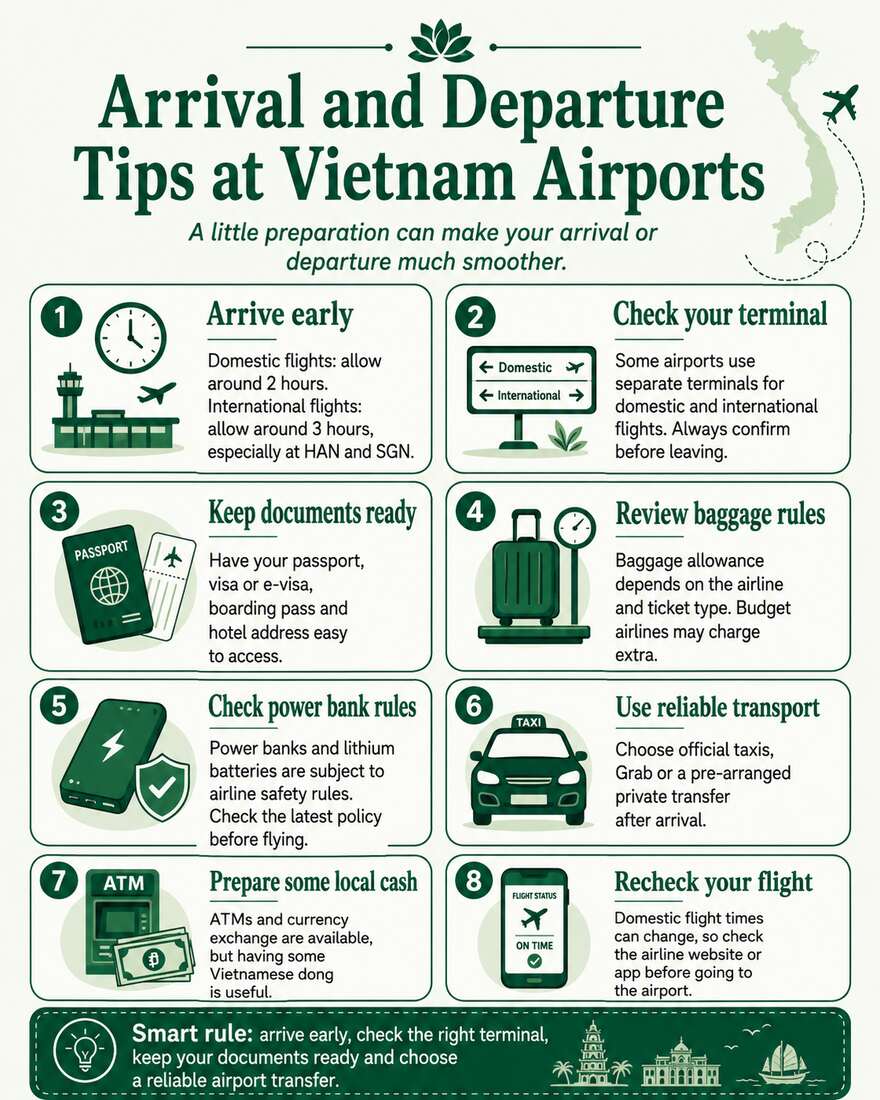
Arrival and Departure Tips at Vietnam Airports
Airports in Vietnam are generally easy to use, but major airports such as Hanoi, Ho Chi Minh City and Da Nang can get busy, especially during holidays, weekends and peak travel seasons. A little preparation can make your arrival or departure much smoother.
Arrive early enough: For domestic flights, try to arrive at least 2 hours before departure during busy periods. For international flights, allow around 3 hours, especially at major airports such as Tan Son Nhat or Noi Bai.
Check your terminal before leaving: Some airports have separate domestic and international terminals. This is especially important at Noi Bai Airport in Hanoi and Tan Son Nhat Airport in Ho Chi Minh City.
Keep your documents ready: Have your passport, visa or e-visa, boarding pass and hotel address easily accessible, especially when arriving in Vietnam.
Check baggage rules carefully: Baggage allowance can vary depending on the airline and ticket type. Low-cost airlines may charge extra for checked luggage.
Compare low-cost flight options carefully: Low fares may not include checked baggage, seat selection, meals or flexible ticket changes. Check the services included and any additional fees to make sure the total cost still suits your needs. Planning your next trip? Search on KAYAK.
Check baggage procedures for connecting flights: Find out whether your luggage will be transferred automatically to your final destination or whether you need to collect and recheck it. This is especially important when changing airlines or connecting between an international and a domestic flight.
Review power bank rules: Power banks and lithium batteries are usually subject to airline safety rules. Check your airline’s latest regulations before boarding.
Use reliable transport: On arrival, choose official taxis, Grab or a pre-arranged private transfer. This is easier than negotiating prices after a long flight.
Prepare some local cash: ATMs and currency exchange counters are available at major airports, but it is useful to have some Vietnamese dong for small payments, taxis or snacks.
Recheck your flight schedule: Domestic flight times can change, so it is worth checking your airline’s website or app before going to the airport.
Keep your luggage tag after domestic flights: Airport staff may check your luggage stub before you leave the arrival hall, especially on domestic routes.
In short, the most important things are simple: arrive early, check the right terminal, keep your travel documents ready and choose a reliable airport transfer. These small steps can save you stress, especially on your first trip to Vietnam.
What are the major international airports in Vietnam?
The main international airports for travelers in Vietnam are Noi Bai International Airport (HAN) in Hanoi, Tan Son Nhat International Airport (SGN) in Ho Chi Minh City and Da Nang International Airport (DAD) in central Vietnam. Other useful international airports include Cam Ranh Airport (CXR) for Nha Trang and Phu Quoc Airport (PQC) for Phu Quoc Island.
How many airports are there in Vietnam?
Vietnam has 22 operational civilian airports, including 12 international airports and 10 domestic airports.
What transportation options are available from Vietnam airports to the city center?
Most major airports in Vietnam offer several transfer options, including taxis, ride-hailing apps such as Grab, airport buses and private transfers. For first-time visitors, families or late arrivals, a pre-arranged private transfer is often the easiest and most comfortable option.
Do Vietnam airports have free Wi-Fi?
Yes, most major airports in Vietnam offer free Wi-Fi in the terminals. You can also usually find ATMs, currency exchange counters and SIM card shops at international arrival areas.
What is Vietnam’s main airport?
Vietnam does not rely on just one airport for international arrivals. In practice, the country has three key gateways for travelers: Hanoi (HAN) in the north, Da Nang (DAD) in central Vietnam and Ho Chi Minh City (SGN) in the south.
If we speak strictly about the busiest and most important southern gateway, Tan Son Nhat International Airport (SGN) in Ho Chi Minh City is often considered Vietnam’s main airport. But for planning a trip, the “main” airport is the one that best matches your route.
Which airport do you fly to in Vietnam?
Choose your airport according to where your Vietnam itinerary begins. Fly to Hanoi (HAN) if you start with Hanoi, Ninh Binh, Ha Long Bay or the northern mountains. Fly to Da Nang (DAD) if your trip focuses on Hoi An, Da Nang or Hue. Fly to Ho Chi Minh City (SGN) if you begin in southern Vietnam, the Mekong Delta or nearby beach extensions.
For a classic first trip, it is often easier to enter Vietnam in one region and leave from another. For example, you can fly into Hanoi and fly out of Ho Chi Minh City, instead of returning to your first airport at the end.
What is the airport code for Vietnam?
There is no single airport code for Vietnam. Each airport has its own three-letter IATA code. The three codes most travelers should know are HAN for Hanoi, DAD for Da Nang and SGN for Ho Chi Minh City.
When booking flights, it is useful to search with both the city name and the airport code. This helps avoid confusion, especially for destinations such as Hoi An or Ha Long Bay, which do not use their own major international airport code.
Which airport is best for Hoi An?
The best airport for Hoi An is Da Nang International Airport (DAD). Hoi An does not have its own airport, so travelers normally fly to Da Nang and continue by road to Hoi An.
This is one of the most common airport mistakes in Vietnam: searching for a “Hoi An airport” or flying into Ho Chi Minh City for Hoi An. If Hoi An is your goal, DAD is the airport code to remember.
Which airport is best for Ha Long Bay?
For most first-time international travelers, Noi Bai International Airport (HAN) in Hanoi is the most practical airport for Ha Long Bay, especially if the trip also includes Hanoi, Ninh Binh or northern Vietnam.
There are closer regional airports, such as Van Don Airport and Cat Bi Airport, but they may offer fewer flight options depending on your route. If your cruise starts from Hanoi or your itinerary begins in the capital, flying into HAN usually keeps the trip simpler.
Can you fly direct from the US to Vietnam?
Yes, but nonstop options between the US and Vietnam are still limited. Vietnam Airlines operates a direct route between San Francisco (SFO) and Ho Chi Minh City (SGN).
If you are flying from another US city, or if your final destination is Hanoi, Da Nang, Hoi An or Ha Long Bay, you will usually connect through Ho Chi Minh City or another Asian hub such as Seoul, Tokyo, Taipei, Hong Kong or Singapore. Always check the latest schedule with your airline before booking.
Conclusion
Choosing the right airport in Vietnam is not only about finding the cheapest flight. It is about planning the direction of your trip. A good airport choice can save you time, reduce unnecessary transfers and make your itinerary feel much smoother from the first day.
Before booking, think about where your journey should naturally begin and end. For many travelers, it makes more sense to enter Vietnam in one region and leave from another instead of returning to the same airport at the end of the trip.
If you are not sure whether to start in Hanoi, Da Nang or Ho Chi Minh City, build your route first, then choose the airport that saves the most time. Kampá Tour can help you design a logical Vietnam itinerary with the right arrival city, departure city and domestic flight plan.
The southern highlands seem interesting to me. I'm planning to go to Vietnam next July. Can you recommend an airport in Vietnam to get there? I guess Ho Chi Minh City Airport is the most logical choice for visiting the south? What is the weather usually like during this time? Is it possible to take an elephant ride in this region? THANKS.
0Reply
K
Kampá Tour27 Jun 2024
Dear Andy,
The southern highlands of Vietnam feature distinct landscapes and cultures compared to other regions of the country. This area is accessible by air from the major cities in Vietnam. Flights are available to Da Lat or Buon Me Thuot from Hanoi, Da Nang, or Ho Chi Minh City, landing at either Da Lat Airport (Lien Khuong) or Buon Me Thuot Airport. For more information on the highlands of Vietnam, please refer to our detailed guide about Vietnam's Airport.
Additionally, in Hanoi, you can visit Quoc Trinh Gold and Silver Company at 27 Ha Trung, which accepts all forms of exchange without any additional fees.
In terms of weather, July marks the rainy season in the south. Although there may be occasional showers, they are typically brief. The remainder of the day is usually cool and sunny. In contrast, the northern region experiences summer temperatures ranging from 30 to 35 degrees Celsius. For more detailed weather information, I recommend reading our article on Vietnam in July.
Should you require any further information, please feel free to contact me.
Sincerely!
0Reply
M
Mike Terrell07 Jul 2026
If you are looking for interesting things to do, go to Boun Ma Thuot and visit the World Coffee Museum. Even if you don’t drink coffee! But If you try some you will probably decide that you actually do love it. The museum highlights the details of how Vietnam became the world’s second largest coffee exporter. It is an AMAZING story 🙂
Planning your trip?
Save time and get expert advice for FREE!
✅ 15 years of local experience
✅ Save up to 40 hours of planning
✅ Travel stress-free from start to finish
Book your free consultation today!







 Our team
 Our team
 Our team
 Our team

.jpg)
.jpg)
.png)

.jpg)
.jpg)

.jpg)
%20(1).jpg)



 Other
Other Add us as a preferred source










Dear Andy,
The southern highlands of Vietnam feature distinct landscapes and cultures compared to other regions of the country. This area is accessible by air from the major cities in Vietnam. Flights are available to Da Lat or Buon Me Thuot from Hanoi, Da Nang, or Ho Chi Minh City, landing at either Da Lat Airport (Lien Khuong) or Buon Me Thuot Airport. For more information on the highlands of Vietnam, please refer to our detailed guide about Vietnam's Airport.
Additionally, in Hanoi, you can visit Quoc Trinh Gold and Silver Company at 27 Ha Trung, which accepts all forms of exchange without any additional fees.
In terms of weather, July marks the rainy season in the south. Although there may be occasional showers, they are typically brief. The remainder of the day is usually cool and sunny. In contrast, the northern region experiences summer temperatures ranging from 30 to 35 degrees Celsius. For more detailed weather information, I recommend reading our article on Vietnam in July.
Should you require any further information, please feel free to contact me.
Sincerely!