Vietnam E-Visa 2026: Your Gateway to Seamless Travel
Applying directly at the embassy for a Vietnam visa or using the option of Vietnamese visa on arrival is available for passengers. Long queues take so much time, whereas applying for the visa through the Vietnam E-visa is the best option to get your travel papers done ahead of time.
An important question may come to mind, which would induce a headache: the pricing on Vietnam e-Visa or just the thought of lengthy documentation? Relax because we have put together the most comprehensive guide to getting your Vietnam e-visa while you enjoy every bit of this lovely trip that you have awaited for so long.
Written by Thom DOAN (Travel Consultant)
Updated on Jun 24, 2026
0 comment
Thom DOAN, a multilingual expert fluent in French and English, is a distinguished travel consultant at Kampá Tour. With an illustrious career spanning multiple countries in Asia, Thom brings a wealth of global insights and profound terrain knowledge. Her deep-rooted passion for exploring diverse cultures and landscapes enriches her professional acumen, which she eagerly shares through her compelling articles on this blog. For any inquiries or to gain further insights, please don't hesitate to pose your questions in the comments section of this article, where Thom will directly engage and provide her expert advice.
A visa may not be necessary for you if you hold a passport from one of the visa-exempt countries and plan to spend 45 days or fewer in Vietnam. You simply land in the country and receive an entry stamp, this is called a 'Visa Exemption.'
As of 2026, Vietnam grants visa-free entry to citizens of 38 countries: France, Italy, Spain, Germany, United Kingdom, Russia, Japan, South Korea, Denmark, Sweden, Finland, Norway, Belarus, Belgium, Bulgaria, Croatia, Czech Republic, Hungary, Luxembourg, Netherlands, Poland, Romania, Slovakia, Slovenia, Switzerland
However, all citizens of Australia, Canada, the USA, India and other non-exempt nationalities must obtain a visa to enter Vietnam, unless they hold: a valid temporary residence card, a valid 5-year visa exemption certificate, or a valid APEC card.
New 2026 Requirement — Digital Arrival Card: From April 15, 2026, all foreign travelers arriving at Tan Son Nhat International Airport (Ho Chi Minh City – SGN) must complete a free Digital Arrival Card before reaching immigration. Submit it up to 72 hours before arrival at the official portal: prearrival.immigration.gov.vn. You will receive a QR code to show at the immigration counter.
Important: This is separate from your visa or visa exemption — both are required. Currently mandatory only at SGN; Hanoi (Nội Bài) and Da Nang airports are not yet affected, though a nationwide rollout is planned.
2. Required documents for applying for the Vietnam e-visa
Once you have confirmed your eligibility to obtain an online visa for Vietnam, please make sure to check the list of mandatory documents required for the application:
Valid Passport: Minimum validity of six months from your date of entry.
Passport-sized Photo: In .jpg format.
Identity Photo: In .jpg format (4x6 cm).
Valid International Credit or Debit Card: For payment.
Email Address: To receive your e-visa and notifications.
Temporary Address in Vietnam: The address of your booked hotel or accommodation.
3. How to obtain an e-visa for Vietnam?
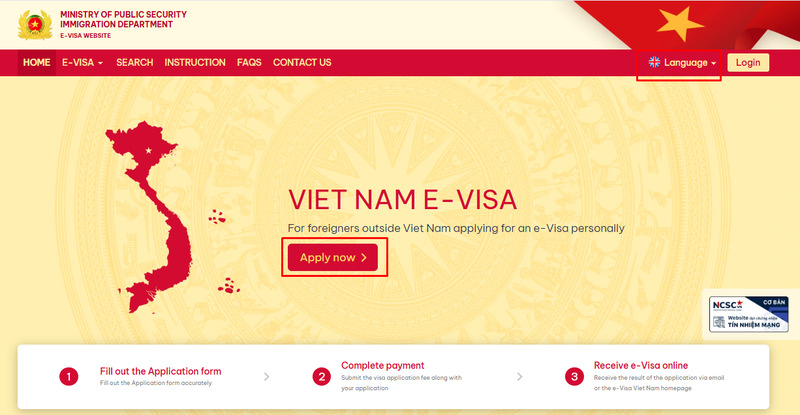
Step 1: Go to the official Vietnam e-visa portal: https://evisa.xuatnhapcanh.gov.vn. Select "English" at the top of the page, then click "Apply now."
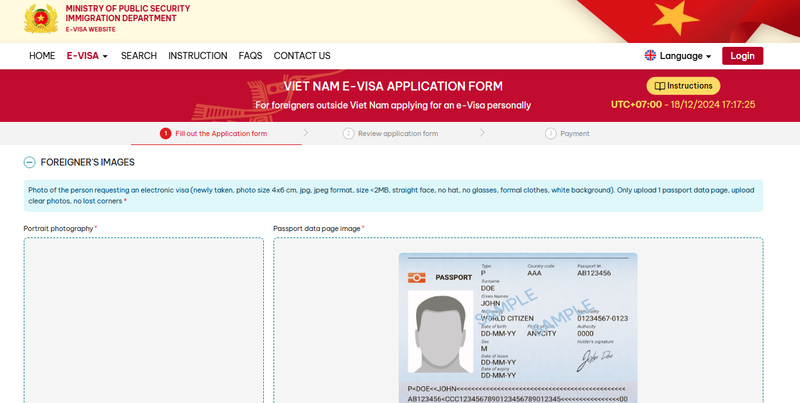
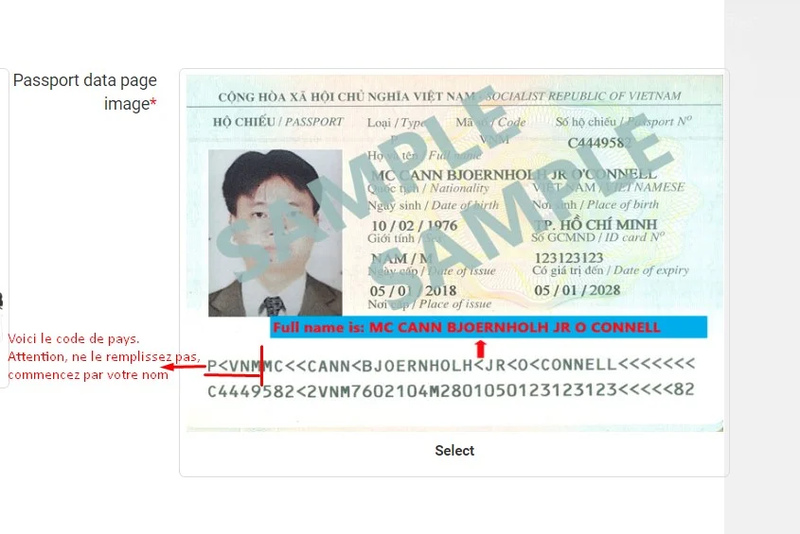
Step 2: Fill in the application form carefully as shown in the image below.
Important: Fill in your first and last name exactly as they appear in your passport.
Fill in your first and last name very carefully as in the example. Be careful, start with your name. Don't confuse it with the country code!
Upload a recent passport-sized photo (4x6 cm, .jpg or .jpeg format, file size under 2 MB, face clearly visible from the front, no hat or glasses, plain white background).
Upload a clear scan of your passport's biographical data page — ensure no corners are cut off.
Processing time is 3 to 5 business days. Applications requiring corrections (name, passport number errors, etc.) may take 1 to 2 weeks. We recommend applying at least one month before travel.
Step 3: Make your payment by debit or credit card. After paying, you will receive a confirmation email that your application has been submitted and is being processed.
Step 4: After processing, check your result at the E-visa search page using your registration code, email, and date of birth. If approved, download and print your e-visa to present upon arrival in Vietnam.
You may enter Vietnam on any date within your e-visa's validity period. Entry before or after the specified dates is not permitted.
Note: If the main portal is unavailable due to server load, you can access Vietnam's Ministry of Public Security services at: https://dichvucong.bocongan.gov.vn
4. Which entry points is the Vietnam e-visa valid for?
Holders of an e-visa can enter and exit Vietnam through any of the 33 international checkpoints.
International Airports:
Cat Bi International Airport (HPH)
Cam Ranh International Airport (CRX)
Can Tho International Airport (VCA)
Da Nang International Airport (DAD)
Noi Bai International Airport (HAN)
Phu Bai International Airport (HUI)
Phu Quoc International Airport (PQC)
Tan Son Nhat International Airport (SGN)
Land Crossings:
Bo Y Border Crossing
Cha Lo Border Crossing
Cau Treo Border Crossing
Huu Nghi Border Crossing
Ha Tien Border Crossing
Lao Bao Border Crossing
Lao Cai Border Crossing
La Lay Border Crossing
Moc Bai Border Crossing
Mong Cai Border Crossing
Nam Can Border Crossing
Na Meo Border Crossing
Song Tien Border Crossing
Tinh Bien Border Crossing
Tay Trang Border Crossing
Xa Mat Border Crossing
Seaports:
Chan May Port
Da Nang Port
Duong Dong Port
Hon Gai Port
Hai Phong Port
Nha Trang Port
Quy Nhon Port
Ho Chi Minh City Port
Vung Tau Port
E-visa holders must present their printed Vietnam e-visa along with a valid passport at the checkpoint. At the airport, the immigration officer may ask for your passport and hotel booking address before stamping your passport.
If you are arriving at Tan Son Nhat Airport (Ho Chi Minh City), remember to also have your Digital Arrival Card QR code ready (see Section 1 above).
Payment is made online via credit or debit card during the application. Please note that e-visa fees are non-refundable, even in cases of rejection or non-use.
Choose one of the payment methods listed on the official Vietnamese immigration website.
Provide the required card information and click "Pay" to complete the process.
Keep your payment confirmation — you will need your registration code to check your application status.
6. Why can't I pay for my Vietnam eVisa?
Payment issues on the official e-visa portal are occasionally reported, often due to IP address restrictions. If your payment is being declined, try the following:
Use a VPN (such as Urban VPN) and switch your IP to an Asian country, the USA, or Germany, then attempt the payment again.
Try a different credit or debit card — some international cards are blocked by the system.
Clear your browser cache or try a different browser.
7. What happens if you exceed the duration of your Vietnam e-visa?
Overstaying your visa in Vietnam carries escalating fines:
$25 for up to 3 days,
$55 for 4 to 10 days,
$175 for 11 days to 1 month,
Up to $700 for overstays exceeding 1 year
Intentional overstaying is recorded in your passport and may impact future visa applications. You could also be blacklisted by Vietnamese immigration, making re-entry significantly more difficult.
8. Vietnam E-Visa FAQs
What if I can't make the payment?
Try using a VPN set to an Asian country, the USA, or Germany, then retry the form and payment (see Section 6 above for more tips).
How long does it take to get an e-visa?
Typically 3 to 5 business days. Allow up to 2 weeks if corrections are needed.
When should I apply for my e-visa?
We recommend applying at least one month before your trip to allow time to resolve any issues.
Do I need both an e-visa and the Digital Arrival Card?
If you are flying into Ho Chi Minh City (SGN), yes — both are required and are separate processes. The e-visa is your entry permit; the Digital Arrival Card is a pre-arrival immigration declaration, free to complete at prearrival.immigration.gov.vn within 72 hours of arrival. If you're landing at Hanoi or Da Nang, the Digital Arrival Card is not yet required.
I'm from a visa-exempt country. Do I still need an e-visa?
Not for stays under 45 days — the visa exemption covers you. However, if you want to stay longer than 45 days, you can apply for an e-visa (up to 90 days) either before your trip or after a brief visa run to a neighboring country.
Our Final Words
The Vietnam e-visa remains the quickest and easiest way to secure your entry online — no embassy visit, no paperwork hassle. Just follow the steps above, upload your documents, and you'll have your visa in a few business days. If you're flying into Ho Chi Minh City, don't forget to also complete the Digital Arrival Card before you board.
Any questions? Feel free to contact the Kampá Tour team — we're happy to help you prepare for a smooth, stress-free arrival in Vietnam. Have a wonderful trip!
Planning your trip?
Save time and get expert advice for FREE!
✅ 15 years of local experience
✅ Save up to 40 hours of planning
✅ Travel stress-free from start to finish
Book your free consultation today!




 Our team
 Our team
 Our team
 Our team




 Other
Other Add us as a preferred source