Vietnam Travel Tips: 15 Essential Tips Before Your Trip
Planning a trip to Vietnam is exciting, but it also brings a lot of practical questions: Do you need a visa? How much cash should you carry? Is the traffic really that difficult? What should you pack for the North and the South? This guide brings together 15 essential Vietnam travel tips to help you prepare clearly, avoid common surprises and feel more confident once you arrive.
Written by Oliver PHUNG (Tour Guide)
Updated on Jul 07, 2026
0 comment
Oliver Phung is a Northern Vietnam-based tour guide and blogger. His favorite topics to write about include cuisine, culture, travel, and under-the-radar experiences. Oliver possesses a deep, detailed understanding of the region, from the indigenous culture of the Hmong in the Northwest to the highland lifestyle of the Tay in the Northeast. Whether he is exploring ancient architecture or geological landscapes, he is always eager to share his insights with his readers.
Beyond his work at Kampá Tour, he produces specialized travel content on platforms such as Reddit, Instagram, LinkedIn, and various other publications.
Your passport validity and Vietnam visa requirements.
Your route, because weather can be very different between the North, Central Vietnam and the South.
A mix of cash and card, with Vietnamese dong for small daily expenses.
A local SIM card or eSIM if you plan to use Grab, Google Maps or translation apps.
Travel insurance covering medical care and repatriation.
1. Check Vietnam entry requirements before booking
Passport and visa rules
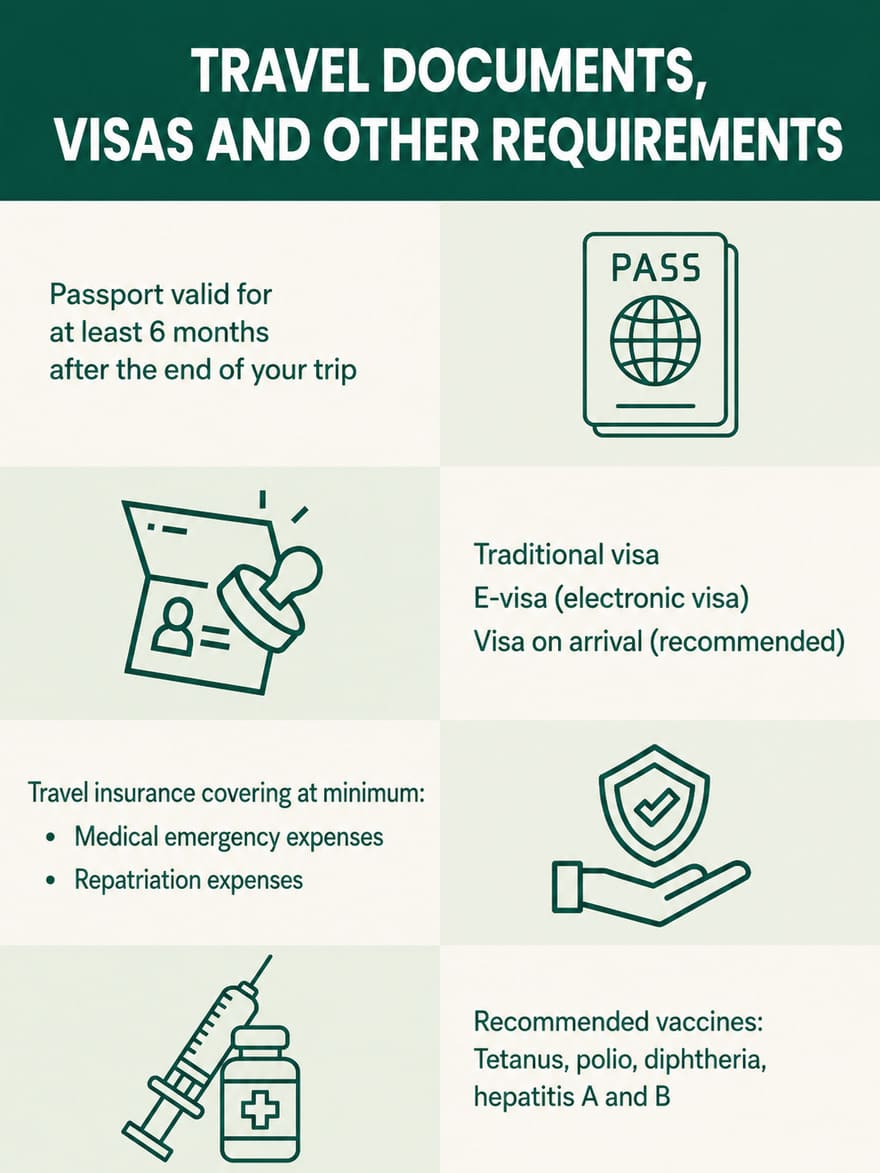
For most travelers, the first thing to check is simple: your passport should be valid for at least 6 months after your planned departure from Vietnam. Airlines and border officers may refuse boarding or entry if your passport is close to expiry, even if your trip is short.
Vietnam visa rules depend on your nationality and length of stay. If you are reading from the United States, Canada or Australia, you should normally plan to apply for a Vietnam e-visa before departure. UK passport holders and several European passport holders, including France, Germany, Italy and Spain, may be eligible for a short visa-free stay of up to 45 days.
The Vietnam e-visa generally allows a stay of up to 90 days, with single-entry or multiple-entry options depending on your application. If your trip combines Vietnam with Cambodia, Laos or Thailand, check the number of entries carefully. A multiple-entry e-visa may be safer if you leave Vietnam and return later in the same journey.
Do not rely on an old blog post or a travel forum for visa rules. Before booking flights, check the official Vietnam e-visa or immigration website, especially if your itinerary includes more than one entry into Vietnam.
No vaccination is generally required simply to enter Vietnam, but it is still wise to check routine vaccines before departure. If your itinerary includes remote forest areas, multi-day trekking or nights in simple mountain villages, ask your doctor or travel clinic for personalized advice.
Travel insurance is strongly recommended. At a minimum, choose coverage for emergency medical expenses and repatriation. Some credit cards include travel insurance when you use the card to buy your flights, but the conditions vary, so read the details before relying on it.
2. Plan your Vietnam travel budget and use Vietnamese dong
Vietnam is still an affordable destination compared with many long-haul travel countries, especially for meals, local transport and simple accommodation. That said, your budget can vary a lot depending on hotel category, domestic flights, private transfers, guides and the pace of your trip.
Travel style
Typical choices
Rough budget guide
Simple budget
2-star hotels, local meals, buses or trains, simple activities, and limited guided services.
Accommodation: around US$25–30/night
Meals: around US$12–18/day/person
Transport: around US$17/day/person
Activities: around US$9/day/person
Estimated 2-week budget: around US$700–850/person, excluding international flights.
Comfort
3-star hotels, a mix of domestic flights, trains, cars, and guided visits.
Accommodation: around US$35–65/night
Meals: around US$17–30/day/person
Transport: around US$30/day/person
Activities: around US$9/day/person
Estimated 2-week budget: around US$1,700/person, excluding international flights.
Higher comfort
4-star or boutique hotels, private transfers, selected cruises, and private guides.
Accommodation: around US$115–340/night
Meals: around US$25–40/day/person
Transport: around US$35/day/person
Activities: around US$15/day/person
Estimated 2-week budget: from around US$2,600/person, excluding international flights.
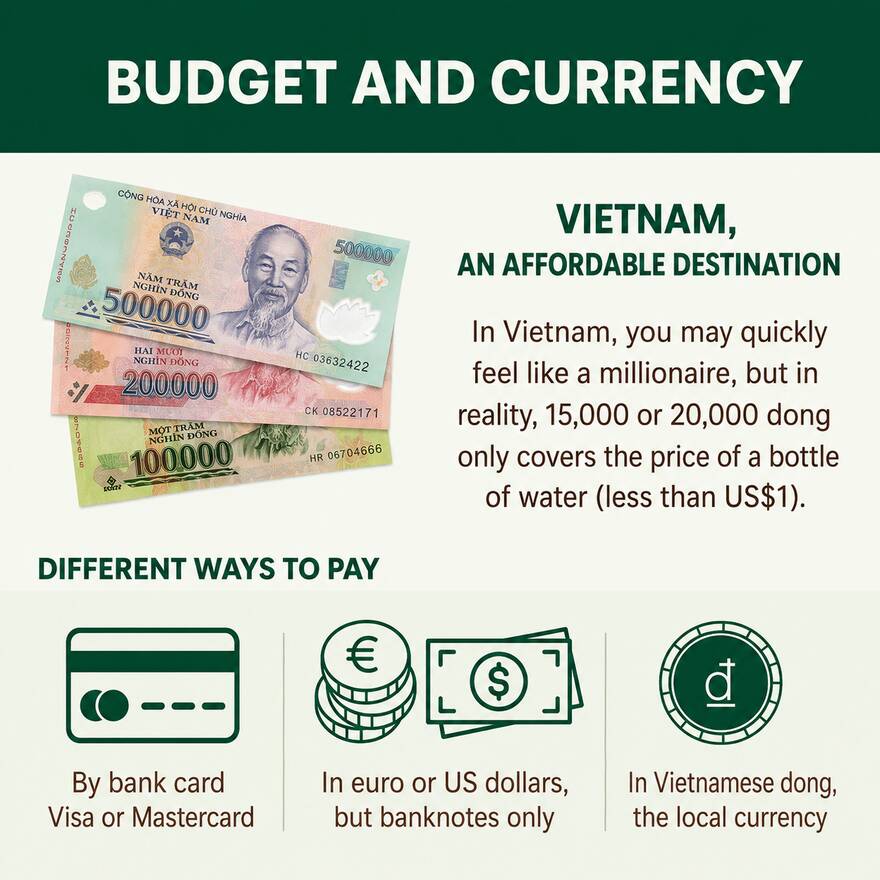
The local currency is the Vietnamese dong (VND). International cards such as Visa and Mastercard are accepted in many hotels, higher-end restaurants and larger shops, but cash is still useful for markets, small restaurants, taxis, tips, street food and rural areas. Vietnamese banks or payment terminals may also apply card fees.
It is usually easier to exchange money after arriving in Vietnam, at banks, exchange counters, airports or reputable gold shops. Keep small notes for daily expenses. A 500,000 VND note is common, but it can be inconvenient when paying for a bottle of water, a short taxi ride or a local snack.
Carry a mix of small notes such as 10,000, 20,000, 50,000 and 100,000 VND. It makes everyday payments smoother, especially outside big hotels and restaurants.
Should you tip in Vietnam?
Tipping is appreciated but not compulsory. In private tours, many travelers choose to tip guides and drivers at the end of each region or travel leg, depending on service quality. For small services such as cyclo rides, boat rowers or porters, a modest tip is welcome if the service was good.
3. First trip to Vietnam: is it safe to travel solo?
For the first 24 hours, Vietnam can feel like a lot: scooters everywhere, markets spilling onto the pavement, food stalls on every corner, and a street rhythm that may be very different from home. Then, usually after the first day or two, most travelers start to settle into it.
On the usual tourist routes, serious safety problems are uncommon. What first-time visitors are more likely to face are smaller travel hassles: a taxi price that is not clear, a rushed purchase in a market, a crowded bus station, or a moment of confusion when traffic feels too close.
Solo travelers often find Vietnam easier than expected. It is usually simple to meet people in hostels, on day tours, on overnight trains or over a bowl of noodles. In rural areas, communication may be limited, but gestures, smiles and a translation app can solve more situations than you might think.
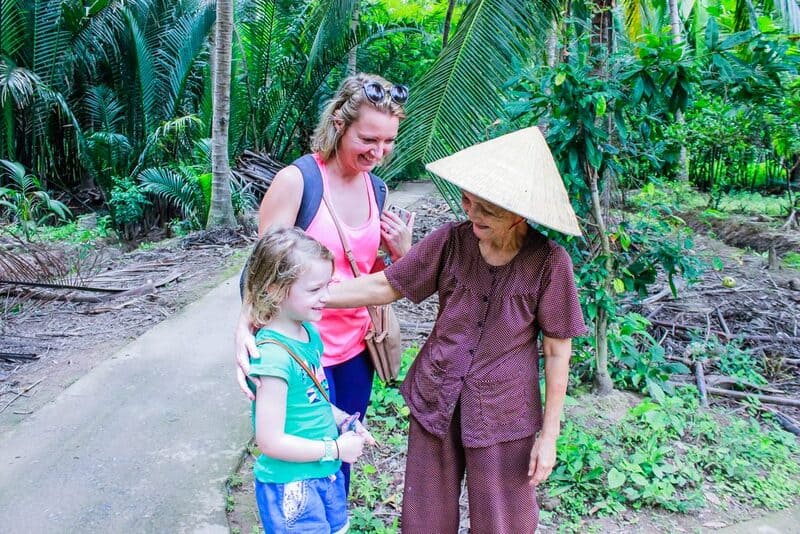
Many travelers remember the small moments of local help as much as the landscapes.
>>> If it is your first time in Vietnam:
Start with a well-planned route instead of trying to see everything.
Book your first airport transfer or hotel pickup in advance if you arrive late.
Keep your passport in the hotel safe and carry a copy or photo when needed.
Use ride-hailing apps in big cities to avoid price confusion.
4. Understand Vietnamese culture, etiquette and useful phrases
A little cultural awareness goes a long way in Vietnam. Most mistakes are forgiven when travelers are polite, but a few simple rules help you avoid awkward moments, especially in temples, pagodas, family homes and rural communities.
What not to do in Vietnam
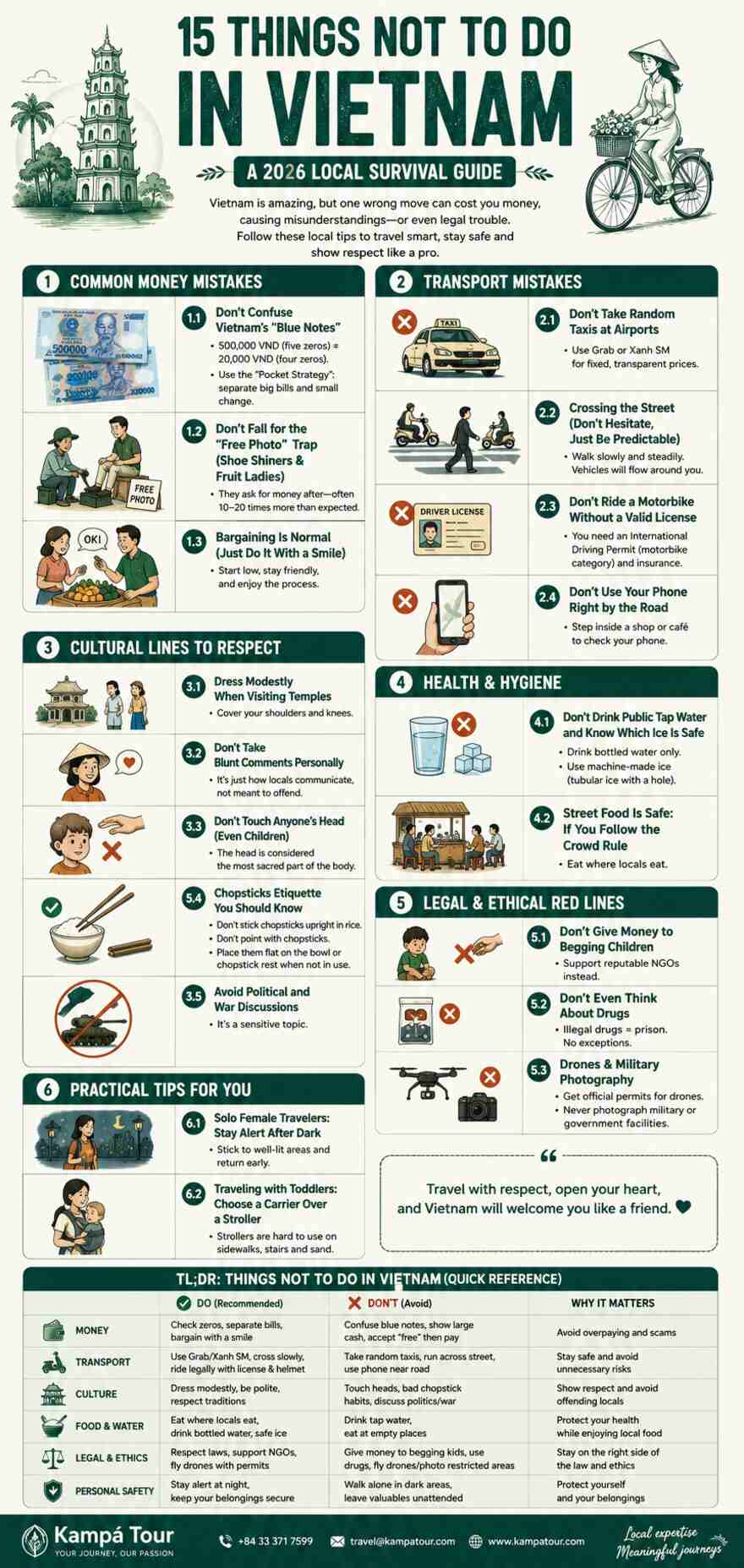
Do not stick chopsticks upright in a bowl of rice. It resembles incense sticks used for the dead.
Avoid losing your temper in public. Keeping face is important in Vietnamese culture.
Do not joke disrespectfully about Buddha or religious images.
When visiting temples and pagodas, cover your shoulders and knees.
Ask before taking close-up photos of people, especially in ethnic minority villages.
You do not need to speak Vietnamese to travel in Vietnam, especially in tourist areas. Hotels, restaurants and tour services in major destinations usually have staff who speak some English. Still, a few words always make a good impression.
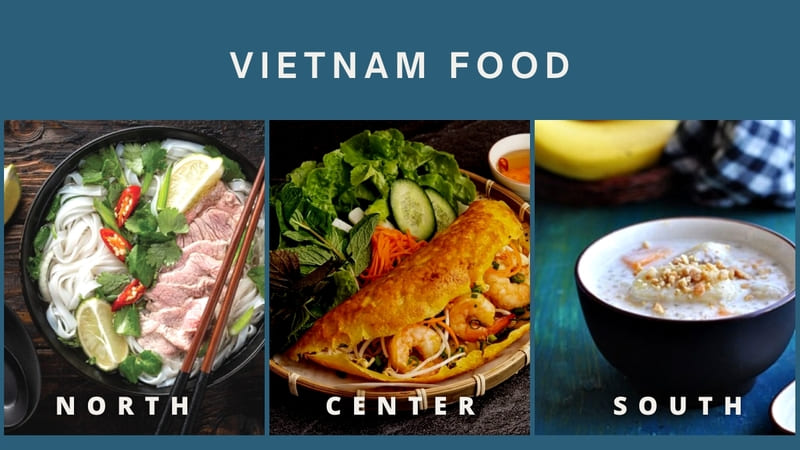
In Vietnam, food is not a side detail of the trip. For many travelers, it becomes one of the strongest memories: a hot bowl of noodles in Hanoi, grilled seafood by the coast, or a family-style lunch in the Mekong Delta.
Some dishes are famous across the country, such as pho, banh mi, bun cha, banh xeo, com tam and bun bo Hue. Still, try to eat regionally when you can: northern dishes are often lighter and more herb-driven, Central Vietnam is known for bold flavors, and the South tends to be a little sweeter and more generous with fresh greens.
Vietnamese food is varied, fresh and deeply regional.
For street food, follow the local crowd. A busy stall with high turnover is usually a better sign than an empty place with a long menu. During your first days, start with hot, freshly cooked dishes such as pho, bun cha or grilled skewers before trying too many raw herbs or lukewarm snacks.
Can you drink tap water in Vietnam?
Do not drink tap water directly in Vietnam. Use bottled water, filtered water or water that has been boiled properly. Ice in established restaurants and cafés in major cities is usually fine, but if you have a sensitive stomach, be more cautious in very local places.
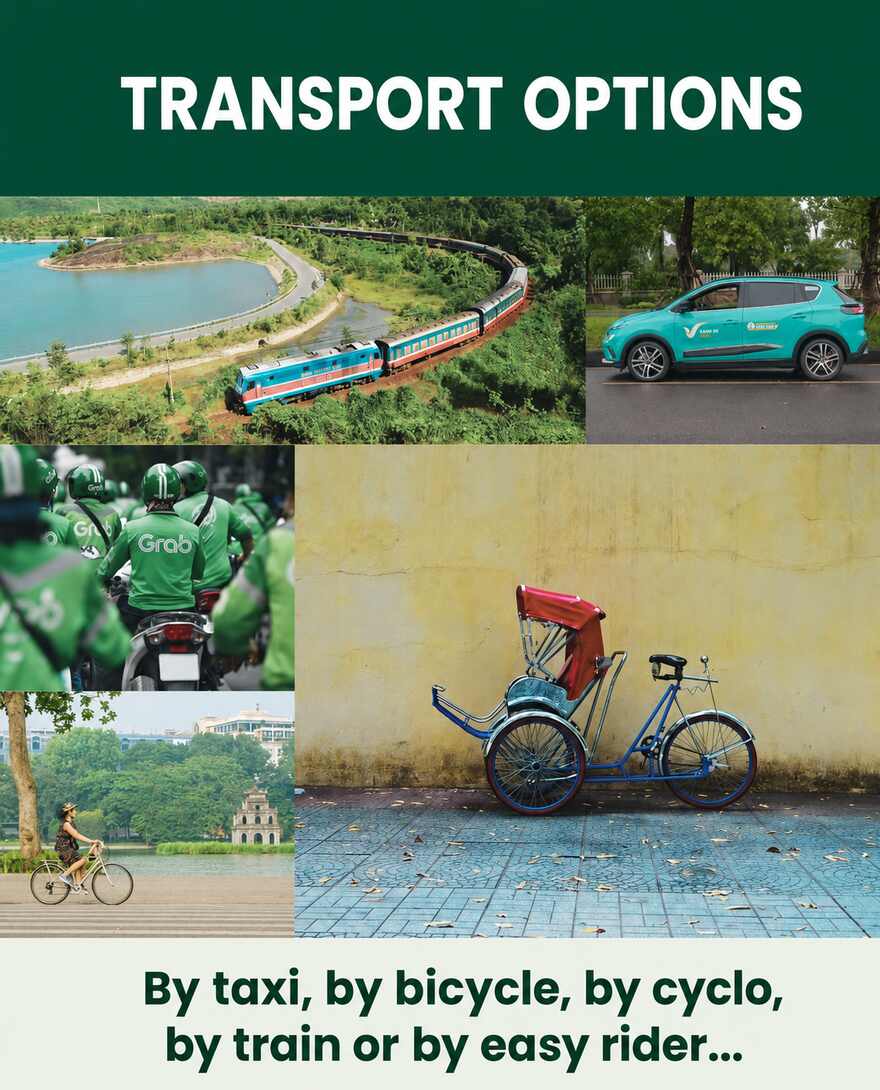
Vietnam is long and narrow, so distances can be misleading on a map. A route that looks simple may take a full day by road or rail. For long distances such as Hanoi to Da Nang, Da Nang to Ho Chi Minh City or Ho Chi Minh City to Phu Quoc, domestic flights often save valuable time.
Trains are slower but scenic, especially on routes such as Hanoi to Ninh Binh, Hanoi to Lao Cai for Sapa, or Hue to Da Nang through the Hai Van Pass. Sleeper buses and limousine vans are useful for regional routes, while taxis and ride-hailing apps are the simplest options inside cities.
Plane: best for long distances and tight schedules.
Train: best for slower travel, scenery and overnight journeys.
Bus or limousine van: useful for regional transfers and lower budgets.
Taxi and ride-hailing apps: easiest for city rides and airport transfers.
Boat: essential in Halong Bay, Lan Ha Bay, Ninh Binh and the Mekong Delta.
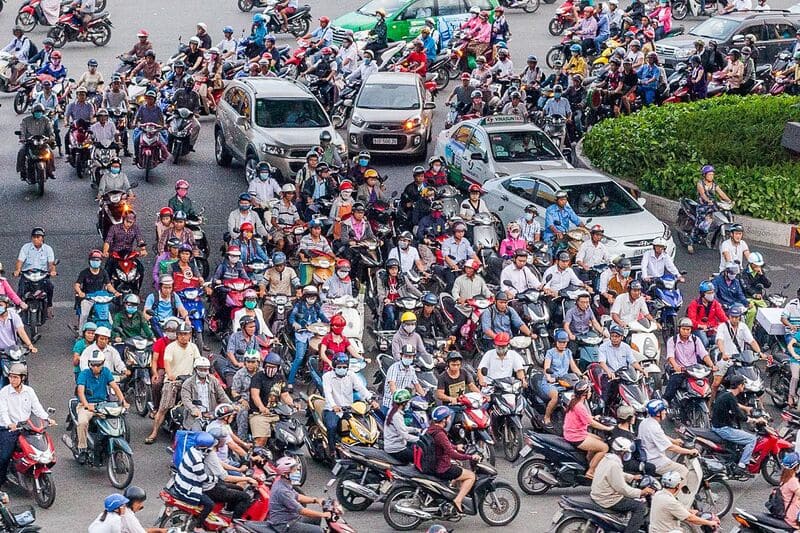
Crossing the street in Vietnam is often one of the first cultural shocks, especially in Hanoi and Ho Chi Minh City. The traffic may look chaotic, but it has its own rhythm. Drivers are used to reading pedestrians and adjusting around them.
The secret is simple: walk slowly, keep a steady pace and avoid sudden movements. Do not run, and do not stop abruptly in the middle of the road. If needed, raise one hand slightly to signal your presence while keeping an eye on the traffic flow.
Traffic in Vietnam can look chaotic, but it follows a rhythm locals understand well.
>>> What to remember:
Do not copy locals blindly on your first day. Choose a crossing point, wait for a manageable gap, walk steadily and let drivers anticipate your movement.
A few apps can make daily travel much easier, especially if this is your first time in Vietnam. Install them before leaving home so you are not doing everything at the airport after a long flight.
Grab: useful for car rides, motorbike taxis and food delivery in many cities.
Be: a Vietnamese ride-hailing app and a good alternative to Grab.
Xanh SM: electric taxi service, often comfortable for airport transfers and city rides.
Google Maps: useful for walking routes, restaurants, bus stops and orientation.
Google Translate: helpful in markets, rural areas and small restaurants.
12Go Asia: useful for checking trains, buses and some regional transfers.
MultiGo: useful for checking public transport routes in Ho Chi Minh City.
9. Stay aware of safety, scams and small travel hassles
Vietnam is safe for most travelers, but the small problems usually happen in the moments when you relax too much: arriving tired at the airport, checking Google Maps beside the road, walking through a crowded night market, or buying quickly without asking the price first.
The two habits that help most are simple: keep your phone away from the traffic side of the street, and agree on the price before accepting anything that looks “free”, such as a photo with fruit baskets, a quick shoe shine or a cyclo ride. Most people are honest, but these small precautions can save you from awkward surprises.
>>> Simple safety habits:
Use official taxi counters or ride-hailing apps at airports.
Check the license plate before getting into an app-based car or motorbike taxi.
Step inside a shop or café before checking your phone or map.
Agree on the price before taking a cyclo, traditional motorbike taxi or street photo service.
Keep valuables in the hotel safe and carry only what you need for the day.
Use a money belt or a small crossbody bag if you feel more comfortable in crowded places.
10. Check Vietnam weather and time difference
There is no single perfect season for all of Vietnam because the country stretches over a long distance from north to south. When one region is rainy, another may be sunny. When the North is cool in winter, the South is usually warm.
As a broad rule, the North has four clearer seasons, Central Vietnam can be affected by heavy rain and storms in some months, and the South is warm all year with a dry and rainy season. For a multi-region trip, build your itinerary around the weather of each region rather than choosing only one national average.
Region
What to expect
North Vietnam
Cooler winters, hot summers, and mountain weather that can change quickly.
Central Vietnam
Beautiful beaches in the dry season, but heavier rain can affect travel during some months.
South Vietnam
Warm year-round, with a dry season and a rainy season.
Vietnam follows GMT+7 all year round and does not use daylight saving time. For travelers from Europe, this means Vietnam is usually several hours ahead: +7 hours from the UK in winter and +6 hours in summer; and +6 hours from France, Italy and mainland Spain in winter, and +5 hours in summer.
For most Vietnam trips, it is better to pack light. A small backpack is useful for day trips, cruises, overnight trains and homestays, while a soft suitcase or larger travel bag can stay at the hotel or in the vehicle during excursions.
North Vietnam in winter or mountain areas: bring a light jacket, warm layers, socks and comfortable walking shoes.
North Vietnam in summer and South Vietnam year-round: bring light breathable clothing, sandals, a hat, sunglasses and sunscreen.
For temples and pagodas: bring clothes that cover shoulders and knees.
For rural areas: bring mosquito repellent and shoes that can handle mud or uneven paths.
Summer in Vietnam is sometimes extremely hot.
Laundry is easy to arrange in most hotels, often within 24 hours, so you do not need to overpack. A small first-aid kit, sunscreen, personal medicine and a copy of your travel documents are more useful than extra outfits.
Power bank rules on domestic flights
>>> Good to know — power banks from July 1, 2026:
On domestic flights in Vietnam, power banks must be carried in cabin baggage and are not allowed in checked luggage. Each passenger may bring a maximum of two power banks, and the capacity should be clearly shown on the device.
Power banks up to 100 Wh are generally accepted without prior approval.
Between 100 Wh and 160 Wh, airline approval may be required.
Power banks above 160 Wh are not allowed.
Using a power bank during the flight, including charging a phone or tablet, is not allowed.
Before taking a domestic flight such as Hanoi – Da Nang or Hanoi – Phu Quoc, check the Wh rating printed on your power bank.
12. Get connected with Wi-Fi, SIM cards or eSIMs
You will find Wi-Fi in most hotels, cafés and restaurants, but mobile data makes the trip much easier. A local SIM card or eSIM is especially useful for maps, translation, ride-hailing apps and contacting your hotel or guide when plans change.
You can buy a SIM card at the airport, in official phone shops or at convenience counters in major cities. Main operators include Viettel, VinaPhone, MobiFone and Vietnamobile. Tourist data packages are usually inexpensive, but prices and data allowances change regularly, so check the package details before paying.
As a rough guide, a local tourist SIM card or eSIM with mobile data usually costs around 150,000 to 350,000 VND, or approximately US$6 to US$15, depending on the operator, data allowance, validity period and where you buy it. Airport kiosks can be convenient, but prices may be slightly higher than at official stores in town.
These SIM cards allow you to use WhatsApp to stay in touch, Google Maps to find your way around, and ride-hailing apps such as Grab, Be or Xanh SM to book transport more easily. They are especially useful on your first day in Vietnam, when you need to arrange airport transfers, check your hotel location or contact your guide.
>>> Local tip:
If you arrive late or have a transfer right after landing, an eSIM activated before departure can make the first day smoother. Otherwise, a local SIM bought at the airport is usually enough.
13. Know where to find international hospitals and clinics
For a normal trip, you hopefully will not need medical care. Still, it is reassuring to know that Vietnam has international hospitals and clinics in the main cities, especially Hanoi, Da Nang and Ho Chi Minh City.
City
International medical facilities
Useful information
Hanoi
French Hospital of Hanoi International SOS Clinic
French Hospital of Hanoi: 1 Phuong Mai Road, Dong Da District Phone: 024-3577-1100 | Emergency: 024-3574-1111
International SOS Clinic: 51 Xuan Dieu Street, Tay Ho District Phone: 024-3934-0666 | Hotline: 08-3829-8520
Da Nang
Vinmec Da Nang International Clinic
Address: 30/4 Street, No.4 Nguyen Tri Phuong Residence, Hoa Cuong Bac Ward, Hai Chau District Phone: 0236-371-1111 | Emergency: 0236-361-1611
Ho Chi Minh City
Vinmec International Clinic Saigon Columbia Asia International Clinic
Vinmec: 2-2 Bis Tran Cao Van Street, District 1 Phone: 028-3520-3388
Columbia Asia: 8 Alexandre De Rhodes Street, Ben Nghe Ward, District 1 Phone: 028-3823-8455 | Emergency: 028-3823-8888
Before traveling, save your insurance assistance number, your embassy contact and the address of a reputable clinic in the city where you will spend the most time. If you travel with medication, bring it in original packaging with a prescription or doctor’s note when possible.
14. Consider planning your trip with a local travel agency
Vietnam is easy to love, but not always easy to organize well. Distances are long, weather varies by region, and the best route depends on your travel style. A local agency can help you avoid rushed transfers, poorly timed flights, unsuitable hotels or routes that look good on paper but feel exhausting in real life.
This is especially useful if you are traveling as a family, as a couple on a special trip, with seniors, or if you want a private itinerary combining culture, nature, local encounters and beach time.
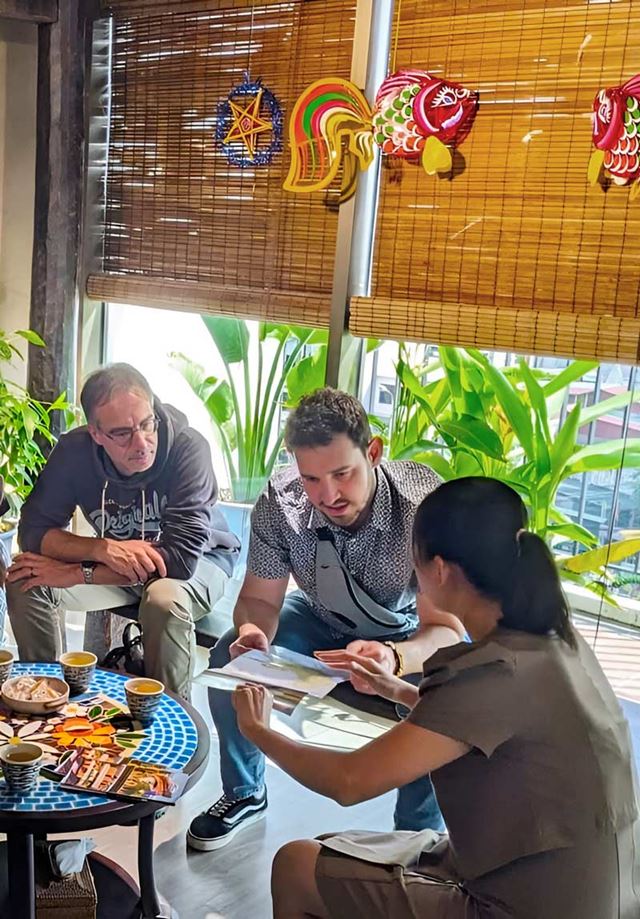
A local travel agency can help turn practical constraints into a smoother itinerary.
At Kampá Tour, our team is based in Vietnam and designs private tailor-made trips across Vietnam and Indochina. We help travelers choose the right route, transport, hotels and local experiences according to their dates, pace and interests.
Emergency numbers are easy to forget when you need them, so save them before your trip. You may never use them, but having them ready is part of good preparation.
Vietnam becomes much easier once the small practical things are handled: the right visa, some cash in Vietnamese dong, clothing suited to your route, a working SIM card and enough time between transfers. With those basics covered, you can stop worrying about logistics and pay attention to the real pleasures of the trip: the food, the landscapes, the people and the rhythm of everyday life.
If you would like help building a smooth private itinerary, feel free to contact our local travel advisors. Share your travel dates, arrival and departure cities, preferred pace and comfort level, and we will help you design a route that fits your trip.
Planning your trip?
Save time and get expert advice for FREE!
✅ 15 years of local experience
✅ Save up to 40 hours of planning
✅ Travel stress-free from start to finish
Book your free consultation today!





 Our team
 Our team
 Our team
 Our team

%20(2).jpg)

.jpg)


 Other
Other Add us as a preferred source