Vietnam is a beautiful and diverse country that attracts millions of tourists every year. However, before you pack your bags and book your flight, you need to know the visa requirements and procedures for entering Vietnam. Depending on your nationality, you may or may not need a visa to visit Vietnam for a certain period of time. In this blog post, we will provide you with the latest information and updates on Vietnam visa 2026, including the visa exemption policy, the electronic visa (e-visa) system, and the visa options for long-term stays. We hope this guide will help you plan your trip to Vietnam smoothly and hassle-free.
Written by Thom DOAN (Travel Consultant)
Updated on Jun 24, 2026
4 comments
Thom DOAN, a multilingual expert fluent in French and English, is a distinguished travel consultant at Kampá Tour. With an illustrious career spanning multiple countries in Asia, Thom brings a wealth of global insights and profound terrain knowledge. Her deep-rooted passion for exploring diverse cultures and landscapes enriches her professional acumen, which she eagerly shares through her compelling articles on this blog. For any inquiries or to gain further insights, please don't hesitate to pose your questions in the comments section of this article, where Thom will directly engage and provide her expert advice.
Update (July 1, 2026): Vietnam now requires mandatory health declarations for all inbound, outbound, and transit travelers under the new Law on Disease Prevention. Declarations must be submitted online or on paper within 7 days before travel. Vaccination certificates or other health documents may be requested depending on the global disease situation. Border quarantine officers will conduct health checks at airports and other border gates.
1. Do I Need a Visa for Vietnam?
It depends on your nationality and the length of your stay. 45-day visa exemption applies to citizens of the following countries — no visa required for stays up to 45 days:
France, Germany, Italy, Spain, United Kingdom, Sweden, Denmark, Finland, Norway, Japan, South Korea, Russia, Belarus — plus, from August 15, 2025 to August 14, 2028: Belgium, Bulgaria, Croatia, Czech Republic, Hungary, Luxembourg, Netherlands, Poland, Romania, Slovakia, Slovenia, and Switzerland.
For stays exceeding 45 days, or if your country is not on the exemption list, you will need a visa. Options include:
An e-visa — the most convenient option, available for citizens of all countries and territories.
A traditional visa issued by the Vietnamese embassy or consulate.
Visa on arrival (air travel only, requires a pre-approved letter).
2. How to Obtain a Visa for Vietnam?
2.1 Traditional Visa
Apply at the Vietnamese Embassy or Consulate in your country. Required documents:
A passport valid for at least 6 months with 2 blank pages.
Visa fee (varies by location). Processing time: 1–2 weeks.
2.2 Vietnam E-Visa (Recommended)
The e-visa is available for citizens of all countries and territories. It is valid for up to 90 days, single or multiple entry, and accepted at 83 international airports, land borders, and seaports. No embassy visit required.
A valid passport with at least 6 months' validity.
Passport photo in .jpg format (4x6 cm, white background, no glasses).
A valid international credit or debit card.
An email address.
A temporary address in Vietnam.
Expected entry and exit dates and border points.
How to apply
Fill out the online application at evisa.gov.vn. Upload your passport photo and data page.
Pay the e-visa fee: $25 for single entry or $50 for multiple entry. Note your registration code.
Processing takes approximately 3–5 business days. Check your result using your registration code, email, and date of birth at evisa.xuatnhapcanh.gov.vn. Print your approved e-visa and present it upon arrival.
The e-visa validity starts from the date specified in the approved document. Entry before or after the validity period is not permitted.
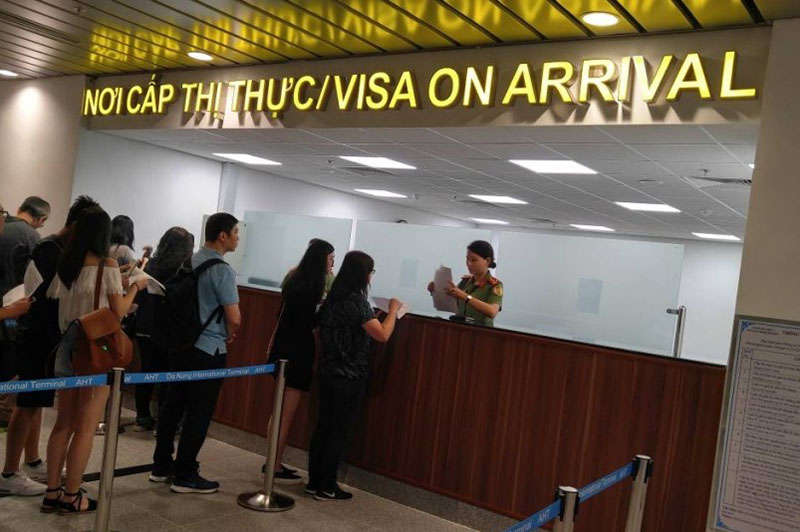
Tourists queuing up for visa on arrival at Noi Bai Airport, Hanoi
2.3 Visa on Arrival
Visa on arrival is available for air arrivals only. You must first obtain a pre-approval letter through a licensed travel agency. Print the letter before your flight, then present it at the immigration counter upon arrival. The visa stamping fee must be paid in cash.
Note:
Not valid for land or sea entry — obtain a full visa in advance if arriving by those routes.
Passport must be valid for at least 6 months beyond your planned stay.
Children with their own passports are charged the same fee as adults.
Stamping fees must be paid in cash; credit cards are not accepted.
There is no official website for this service — all providers are private agencies.
Our recommendation: We strongly recommend the e-visa — it is easier, faster, and less expensive than the other options.
Agency service fee — paid to the visa agency for the approval letter (varies by agency).
Stamping fee — paid in cash at the airport: $25 USD (single entry) or $50 USD (multiple entry). Pay in USD to avoid poor exchange rates.
Special cases: Citizens of some countries including Morocco, Algeria, Tunisia, Kuwait, and Oman may be subject to different procedures. Confirm with the Vietnamese Immigration Department or nearest Vietnamese embassy.
4. What Are the Penalties for Overstaying a Visa in Vietnam?
Overstaying a visa in Vietnam is an administrative violation. Under Decree 282/2025 (effective December 15, 2025), fines have increased significantly:
Up to 15 days: VND 500,000–2,000,000 (~$20–$76)
16–29 days: VND 5,000,000–10,000,000 (~$190–$380)
30–59 days: up to VND 15,000,000 (~$570)
60–89 days: up to VND 20,000,000 (~$760)
Up to 6 months: up to VND 25,000,000 (~$950)
6 months to 1 year: up to VND 30,000,000 (~$1,140)
Over 1 year: up to VND 40,000,000 (~$1,520)
Overstays of 16 days or more may also result in deportation. Serious or repeated violations can lead to a ban on re-entering Vietnam for 1–5 years. If you are approaching your visa expiry date, apply for an extension at least 7–10 days in advance.
I am US citizen, traveling to Vietnam & Camdodia 26FEB- 4April 2027. I will be on an OAT ( Overland Adventure Tour). If I want to get my visa online, do I need a letter from them stating Im on a tour with them. What does this letter do?
0Reply
Kampá Tour13 Aug 2026
😊 You shouldn’t need a letter from OAT if you’re applying for the regular e-visas yourself. For Vietnam, just make sure you get a multiple-entry e-visa if your OAT tour crosses into Cambodia and then back into Vietnam.
The OAT letter is mainly relevant to the old Visa on Arrival process, so it shouldn’t be necessary for an e-visa. I’d just double-check with OAT why they mentioned it, but otherwise you should be all set!
0Reply
M
Mark16 Jul 2026
i'm Irish and I have been travelling Thailand for the past month and I intend to travel to vietnam tommorow. About 2 weeks ago I applied for the evisa. I paid money went through all of that done, It hadn't went through for a week so I checked the status and it said was unpaid when i have the bank reciept of payment. But whatever, I emailed to no reply so I made a new account and repaid about 4 days ago. This one worked and I got an email saying that i put in the middle name and first name the wrong way around so they couldnt put it through. I have recorrected the error but I am still worried that I won't be able to travel tommorow. Does anyone have any suggestions or similar expierence? Any help is greatly appreciated :)
0Reply
Kampá Tour01 Aug 2026
Hi, Mark! Sorry you're dealing with this!
The good news is that since they emailed you asking to fix your name, it doesn't sound like your application was rejected, you've just had to amend it. The downside is that once you submit the correction, it usually goes back into processing, so there's no guarantee it'll be approved by tomorrow.
If it's still not approved by the time you check in, the airline will most likely not let you board, as they'll need to see a valid Vietnam e-visa first.
Hope it comes through in time. Fingers crossed for you! 🤞
Planning your trip?
Save time and get expert advice for FREE!
✅ 15 years of local experience
✅ Save up to 40 hours of planning
✅ Travel stress-free from start to finish
Book your free consultation today!


 Our team
 Our team
 Our team
 Our team







 Other
Other Add us as a preferred source






😊 You shouldn’t need a letter from OAT if you’re applying for the regular e-visas yourself. For Vietnam, just make sure you get a multiple-entry e-visa if your OAT tour crosses into Cambodia and then back into Vietnam.
The OAT letter is mainly relevant to the old Visa on Arrival process, so it shouldn’t be necessary for an e-visa. I’d just double-check with OAT why they mentioned it, but otherwise you should be all set!
Hi, Mark! Sorry you're dealing with this!
The good news is that since they emailed you asking to fix your name, it doesn't sound like your application was rejected, you've just had to amend it. The downside is that once you submit the correction, it usually goes back into processing, so there's no guarantee it'll be approved by tomorrow.
If it's still not approved by the time you check in, the airline will most likely not let you board, as they'll need to see a valid Vietnam e-visa first.
Hope it comes through in time. Fingers crossed for you! 🤞